9 Neumann Studio Monitors Compared: KH Series Guide
Whether you're mixing your next EDM track or fine-tuning a master for release, what you hear through your speakers determines every decision you make. Neumann studio monitors have earned a reputation among producers and engineers for their accuracy, transparency, and build quality, and the KH Series sits at the center of that lineup. At RIKIO ROCKS, we cover the tools and gear that shape electronic dance music, and monitoring is where every great production starts.
Choosing the right pair isn't straightforward, though. Neumann's KH range spans compact desktop models to full-size midfields, each designed for different room sizes, budgets, and use cases. Specs on paper only tell part of the story. Price gaps between models can be significant, and features like DSP room correction or boundary EQ compensation might matter more to your setup than raw driver size. You need a clear side-by-side look at what each monitor actually delivers before spending that kind of money.
That's exactly what this guide provides. We've compared nine Neumann studio monitors from the KH Series, breaking down their specifications, pricing, ideal applications, and standout features. From the compact KH 80 DSP to the flagship KH 420, you'll find the details that matter for making a confident purchase. Whether you're building your first proper studio or upgrading a room that's already treated, this comparison will help you narrow down the right fit without bouncing between spec sheets on ten different websites.
1. Neumann KH 80 DSP
The KH 80 DSP is Neumann's smallest active monitor in the KH lineup, and it punches well above what its size suggests. Producers working in home studios or treated smaller rooms have made this one of the most talked-about compact monitors on the market, thanks largely to its onboard DSP and the MA 1 automatic room calibration system built into the Neumann.Control app.
Sound and voicing in plain English
The KH 80 DSP delivers a very flat, uncolored frequency response that gives you an honest picture of your mix. The low end is tight and controlled rather than hyped, which means your bass decisions will translate well across other playback systems. The top end is detailed without being harsh, so long sessions remain easy on the ears. If you've been mixing on consumer speakers or entry-level monitors, the transparency of this speaker will likely expose issues in your tracks that you didn't know existed.
Experienced engineers describe the KH 80 DSP as sounding more like a large-format monitor compressed into a small cabinet than a typical desktop speaker.
Specs that matter for small rooms
The KH 80 DSP uses a 5.3-inch woofer paired with a one-inch tweeter, both powered by a combined 100 watts of Class D amplification. Its MMD waveguide controls dispersion tightly, which reduces room reflections and keeps the stereo image focused at the mix position. The frequency response runs from 52 Hz to 21 kHz at -3 dB, which covers the core of most EDM production. In a room smaller than 15 by 15 feet, this monitor handles low-frequency content cleanly without overwhelming the space.
Connectivity, controls, and DSP workflow
On the back panel, you get an analog XLR input and an AES3 digital input, plus a USB port for connecting to the Neumann.Control app. The app lets you run MA 1 room calibration, which measures your room with a microphone and applies correction filters automatically. Physical controls include level, input sensitivity, and boundary EQ adjustments, giving you useful flexibility without requiring a deep dive into software every time you want to make a quick tweak.
Typical US price and who should buy it
The KH 80 DSP typically retails for around $899 per speaker, putting a stereo pair at approximately $1,800. That's a serious investment for a compact monitor, but it's justified if you're committed to accurate mixing in a small treated room. Producers who want professional-grade Neumann studio monitors without the footprint of a larger model will find this the easiest entry point into the KH Series.
2. Neumann KH 120 II
The KH 120 II is Neumann's most popular two-way nearfield monitor, and the direct successor to the original KH 120 that became a reference-grade staple in professional studios worldwide. It improves on the original in every measurable way, offering more headroom, deeper low-end extension, and a redesigned waveguide. If the KH 80 DSP feels too compact for your workflow, this is the natural step up.
Sound and voicing in plain English
The KH 120 II sounds wide open and neutral across the full frequency range. Low frequencies stay controlled and articulate, so your kick drum and bass layers sit exactly where you placed them in the mix. The midrange carries real detail, which matters when you're checking vocal chops, synth layers, and atmospheric elements common in EDM production.
Engineers who move from the original KH 120 to the KH 120 II consistently report hearing details in familiar tracks they had missed before.
Specs that matter for small rooms
This monitor uses a 5.75-inch woofer and a one-inch tweeter, with a combined output of 210 watts. The frequency response reaches from 52 Hz to 21 kHz at -3 dB, giving you solid coverage for bass-heavy genres without a subwoofer in a properly treated room.
Connectivity, controls, and DSP workflow
The KH 120 II includes analog XLR, AES3 digital inputs, and a USB port for the Neumann.Control app and MA 1 room calibration. Boundary EQ settings let you compensate for wall and desk placement quickly.
Typical US price and who should buy it
Expect to pay around $1,099 per speaker, placing a stereo pair near $2,200. These neumann studio monitors suit producers and engineers working in home studios or small professional rooms who need accurate, fatigue-free monitoring with room correction built in.
3. Neumann KH 120 II AES67
The KH 120 II AES67 shares the same driver configuration and acoustic performance as the standard KH 120 II, with one critical difference: it replaces the AES3 digital input with AES67 network audio compatibility. If your studio runs a networked audio infrastructure using Dante or AES67 routing, this variant was built specifically for your workflow.
Sound and voicing in plain English
Everything said about the KH 120 II's sonic character applies here. The frequency response is flat and uncolored, giving you the same honest picture of your mix. Low frequencies stay controlled and articulate, so bass-heavy EDM productions translate accurately to other playback systems without surprises.
The acoustic performance is identical to the standard KH 120 II - the AES67 variant simply fits into a different studio infrastructure.
Specs that matter for small rooms
This monitor uses the same core hardware as its sibling, so the listening experience in a small treated room is identical. Room correction via MA 1 still applies, which means placement flexibility remains strong.
|
Spec
|
Value
|
|
Woofer
|
5.75 inch
|
|
Tweeter
|
1 inch
|
|
Amplification
|
210W combined
|
|
Frequency Response
|
52 Hz to 21 kHz (-3 dB)
|
Connectivity, controls, and DSP workflow
This model swaps the AES3 input for AES67 network audio, integrating directly into Dante-based studio setups. You still get the analog XLR input and USB port for Neumann.Control app access and MA 1 room calibration, along with the same boundary EQ adjustment options.
Typical US price and who should buy it
The KH 120 II AES67 runs around $1,399 per speaker. These neumann studio monitors make practical sense for professional studios already running networked audio routing, where AES67 compatibility removes the need for additional conversion hardware in the signal chain.
4. Neumann KH 150
The KH 150 sits between the KH 120 II and the larger three-way KH 310, offering producers who need more headroom and deeper bass extension a clear path forward. It uses a 6.5-inch woofer and runs on the same DSP platform as the rest of the KH lineup, which means MA 1 room calibration and the Neumann.Control app carry over seamlessly.
Sound and voicing in plain English
Neumann tuned the KH 150 to deliver the same flat, neutral character you expect from their neumann studio monitors, but with noticeably more authority in the low end. The larger woofer adds real weight to bass-heavy EDM genres without bloating the low midrange, and high-frequency detail stays crisp and fatigue-free across long mixing sessions.
Producers who regularly work with bass-heavy content report that the KH 150's low-end extension reduces the guesswork that comes with smaller two-way monitors.
Specs that matter for small rooms
Low-end extension reaches down to 39 Hz at -3 dB, which gives you usable bass information without a subwoofer in a medium-sized treated room. The MMD waveguide controls dispersion tightly, reducing comb filtering from side walls and keeping the stereo image focused at the mix position.
|
Spec
|
Value
|
|
Woofer
|
6.5 inch
|
|
Tweeter
|
1 inch
|
|
Amplification
|
210W combined
|
|
Frequency Response
|
39 Hz to 21 kHz (-3 dB)
|
Connectivity, controls, and DSP workflow
Connectivity mirrors the KH 120 II, with analog XLR and AES3 digital inputs plus a USB port for the Neumann.Control app. Boundary EQ adjustments and MA 1 room calibration work identically here, giving you strong placement flexibility across different room configurations.
Typical US price and who should buy it
Expect to pay around $1,499 per speaker, putting a stereo pair close to $3,000. This is the right monitor for producers working in mid-sized treated rooms who want deeper low-end extension and more dynamic headroom than the KH 120 II delivers without moving to a three-way design.
5. Neumann KH 150 AES67
The KH 150 AES67 delivers the same acoustic performance as the standard KH 150 but swaps the AES3 input for AES67 networked audio support. If your studio already routes audio over a Dante or AES67 network, this variant slots directly into that infrastructure without adding conversion hardware to your signal chain.
Sound and voicing in plain English
The sonic character here is identical to the standard KH 150. You get a flat, neutral response with real low-end authority from the 6.5-inch woofer, making it well-suited for bass-heavy EDM production. High-frequency detail stays clean and honest across long sessions, so fatigue rarely becomes a problem when you're deep into a mixing workflow.
The KH 150 AES67 gives you professional-grade neumann studio monitors with networked audio routing built in, removing a layer of complexity from the signal chain.
Specs that matter for small rooms
The core specs match the standard KH 150 exactly, with low-end extension reaching 39 Hz at -3 dB and the same MMD waveguide controlling dispersion to reduce wall reflections. The 210W combined amplification handles dynamic peaks without compression artifacts affecting your translation decisions.
|
Spec
|
Value
|
|
Woofer
|
6.5 inch
|
|
Tweeter
|
1 inch
|
|
Amplification
|
210W combined
|
|
Frequency Response
|
39 Hz to 21 kHz (-3 dB)
|
Connectivity, controls, and DSP workflow
This model replaces the AES3 input with AES67 network audio while keeping the analog XLR input and USB port for the Neumann.Control app and MA 1 room calibration. Boundary EQ adjustments remain available through the app.
Typical US price and who should buy it
Expect to pay around $1,799 per speaker. This monitor suits professional studios running networked audio setups where AES67 compatibility is a practical requirement rather than an optional feature.
6. Neumann KH 310
The KH 310 is Neumann's compact three-way monitor, and it represents a significant shift in design philosophy from the two-way models below it in the lineup. Three separate drivers handle distinct frequency ranges, which reduces intermodulation distortion and gives each part of the spectrum cleaner, more dedicated amplification.
Sound and voicing in plain English
The KH 310 delivers a level of midrange resolution that two-way monitors simply cannot match. Bass stays deep and controlled, while the dedicated midrange driver surfaces detail in vocals, synths, and layered harmonic content that often gets masked in less capable speakers. The top end remains honest and fatigue-free across long sessions.
Producers who mix complex, layered EDM arrangements report that the KH 310 exposes arrangement problems early, saving significant revision time downstream.
Specs that matter for small rooms
The KH 310 uses an 8.5-inch woofer, a 3-inch midrange driver, and a 1-inch tweeter, driven by 300 watts of combined Class D amplification. Low-end extension reaches 34 Hz at -3 dB, giving you genuinely useful sub-bass information in a properly treated room without requiring a subwoofer.
|
Spec
|
Value
|
|
Woofer
|
8.5 inch
|
|
Midrange
|
3 inch
|
|
Tweeter
|
1 inch
|
|
Amplification
|
300W combined
|
|
Frequency Response
|
34 Hz to 21 kHz (-3 dB)
|
Connectivity, controls, and DSP workflow
The KH 310 provides an analog XLR input and AES3 digital input, along with physical boundary EQ controls for wall and desk placement compensation. These neumann studio monitors support MA 1 room calibration through the Neumann.Control app via USB.
Typical US price and who should buy it
The KH 310 retails for around $3,995 per speaker. This monitor suits producers and engineers working in larger treated rooms who need three-way accuracy and deeper low-end extension without adding a dedicated subwoofer to the monitoring chain.
7. Neumann KH 420
The KH 420 is Neumann's flagship three-way midfield monitor and the largest standalone speaker in the KH lineup. It carries the same DSP platform as the rest of the series, but the larger cabinet and driver configuration push it into a different league of performance, designed for bigger rooms and more demanding critical listening environments.
Sound and voicing in plain English
The KH 420 delivers extraordinary resolution across the entire frequency range. The dedicated midrange driver exposes harmonic layers in complex EDM arrangements with a level of clarity that two-way monitors cannot replicate, and the low end extends deep without losing definition. Long mixing sessions on this speaker leave your ears far less fatigued than smaller monitors because each driver handles a narrower, more controlled portion of the spectrum.
Engineers working in properly treated midfield positions consistently report that the KH 420 surfaces mix problems earlier in the workflow, reducing revision cycles significantly.
Specs that matter for small rooms
The KH 420 is genuinely designed for larger treated spaces rather than compact home studios. Its 10-inch woofer, 3-inch midrange driver, and 1-inch tweeter deliver a combined 500 watts of Class D amplification, with low-end extension reaching 33 Hz at -3 dB.
Connectivity, controls, and DSP workflow
These neumann studio monitors include analog XLR and AES3 digital inputs along with a USB port for the Neumann.Control app. MA 1 room calibration and boundary EQ adjustments work exactly as they do across the broader KH lineup, giving you the same correction workflow in a larger monitoring context.
Typical US price and who should buy it
The KH 420 retails for around $5,995 per speaker. This monitor suits professional engineers and serious producers who work in larger treated rooms and need flagship-level accuracy without adding a separate subwoofer to the monitoring chain.
8. Neumann KH 750 DSP subwoofer
The KH 750 DSP is a compact active subwoofer built specifically to integrate with Neumann's KH lineup. It runs on the same DSP platform as the rest of the series, which makes system-level alignment far simpler than pairing a third-party subwoofer with your main monitors.
What it adds to a KH setup
Adding the KH 750 DSP to a KH 80 DSP or KH 120 II system fills the low-frequency gap those two-way monitors leave below 50 Hz. You get genuine sub-bass extension into the 18 Hz range, which matters when you're checking bass drops, rumble layers, and kick transients in EDM production. The subwoofer integrates with the Neumann.Control app, so your entire monitoring chain shares a unified calibration workflow rather than requiring separate adjustment per component.
Engineers running the KH 750 DSP with KH 120 II monitors report a noticeably more complete picture of low-end content compared to running the satellites alone.
Specs that matter for placement and crossover
The KH 750 DSP uses a 9.5-inch woofer powered by 256 watts of Class D amplification. Low-end extension reaches 18 Hz at -3 dB, and the cabinet is relatively compact given that output level. A configurable crossover frequency gives you control over where the subwoofer hands off to your main speakers.
Bass management, DSP, and alignment options
The onboard DSP handles delay, level, and crossover alignment automatically through the Neumann.Control app and MA 1 calibration. You can fine-tune placement compensation for corner or wall proximity directly in software.
Typical US price and who should buy it
The KH 750 DSP retails for around $2,249. These neumann studio monitors subwoofer solutions suit producers who want accurate sub-bass extension paired cleanly with their existing KH two-way setup.
9. Neumann KH 810 subwoofer
The KH 810 is Neumann's larger subwoofer option, built for professional studios that need more acoustic output and deeper extension than the KH 750 DSP can provide. It pairs naturally with the KH 310 or KH 420 in larger rooms where a compact subwoofer would struggle to fill the space adequately.
What it adds to a KH setup
Pairing the KH 810 with a three-way KH system adds serious low-frequency output that extends the monitoring chain into territory even the KH 310's 8.5-inch woofer cannot fully cover. For producers working with bass-heavy EDM content, this subwoofer surfaces sub-bass detail that stays invisible on monitors pushing against their low-frequency limits.
Engineers who pair the KH 810 with KH 310 or KH 420 monitors report that sub-bass decisions become significantly more confident and reliable.
Specs that matter for placement and crossover
The KH 810 uses a 12-inch woofer driven by 500 watts of Class D amplification, with low-end extension reaching 16 Hz at -3 dB. Its larger cabinet requires more floor space than the KH 750 DSP, so you need to plan placement carefully before committing to the purchase.
Bass management, DSP, and alignment options
Running on the same DSP platform as the rest of the KH lineup, the KH 810 integrates directly with the Neumann.Control app and MA 1 calibration. Delay, level, and crossover alignment all adjust through the app, keeping your full monitoring chain coherent without requiring manual fine-tuning at the speaker itself.
Typical US price and who should buy it
The KH 810 retails for around $3,799. These neumann studio monitors subwoofer solutions suit professional engineers working in larger treated rooms where the KH 750 DSP's output ceiling becomes a practical limitation for accurate low-frequency monitoring.
Quick picks and next steps
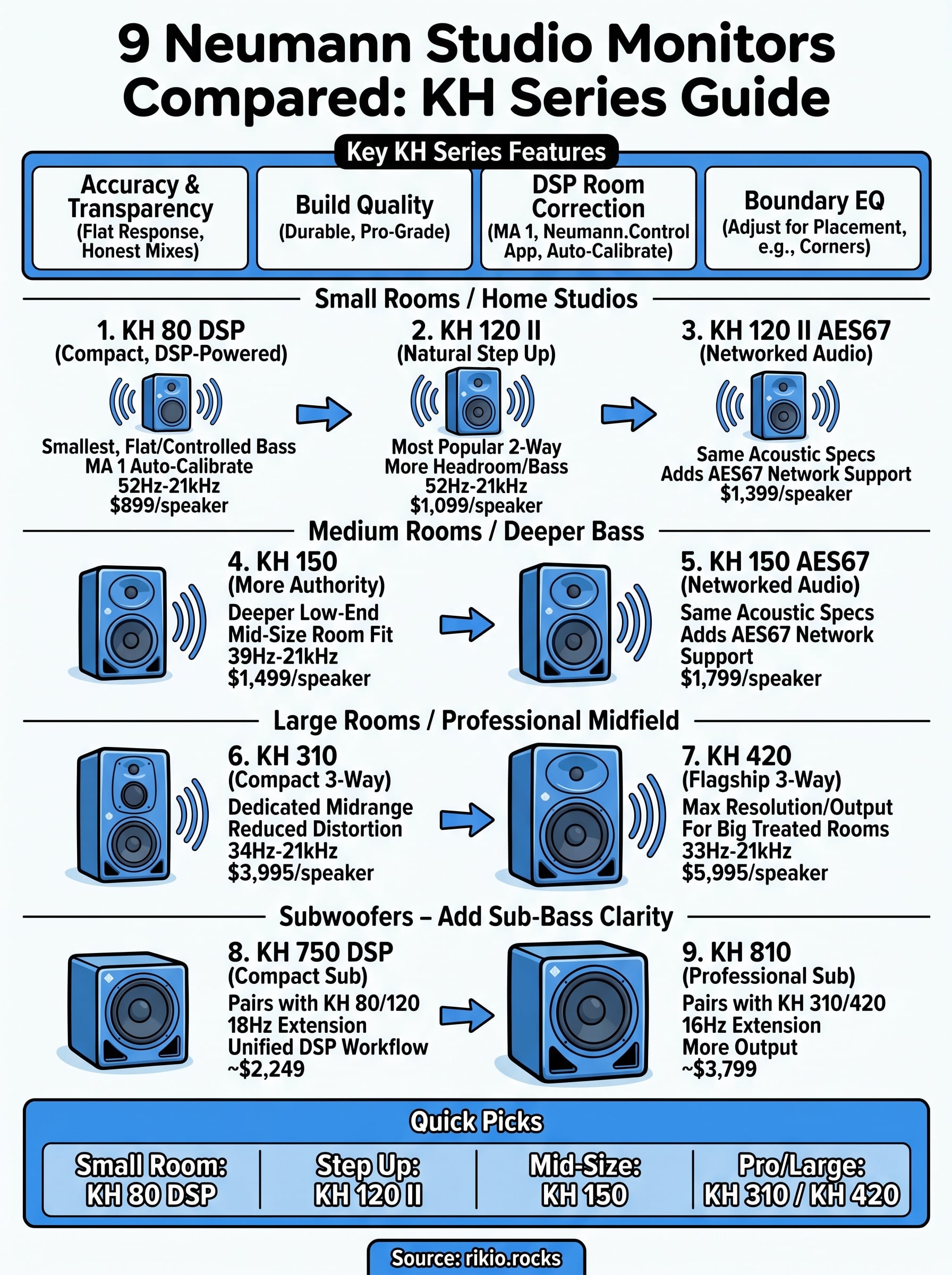
If you're working in a small treated home studio, the KH 80 DSP gives you the most accurate monitoring per square foot in the lineup, while the KH 120 II steps up naturally once you need more headroom and bass extension. Producers running mid-sized rooms with bass-heavy content will find the KH 150 a better fit, and the KH 310 or KH 420 belong in larger professional environments where three-way accuracy becomes worth the investment.
Pairing any two-way Neumann studio monitors with the KH 750 DSP or KH 810 adds sub-bass clarity that makes low-frequency decisions significantly more reliable, especially when producing for high-energy genres like EDM where bass translation matters most. Whatever combination you choose, MA 1 room calibration ties the entire system together.
Once your monitoring chain is dialed in, keep your production inspiration sharp by checking out our CARDIO HITS 2026 Playlist on Spotify for high-energy EDM references to push your next session forward.
14