Who’s Buying All These Vibe-Coded Plugins?

Vibe-coded plugins are everywhere but does that mean that they’re actually taking over the market? We look at the trend and speak with two developers working with AI as part of their process.
The age of vibe-coded plugins is undeniably upon us. They’re everywhere: blocky, dark and uniform instruments and effects that all tend to look the same, with large knobs and small print. Made with the help of artificial intelligence, these plugins are clogging up the marketplace, filling email inboxes with marketing hyperbole and vying for your hard-earned dollar, pound or Euro. But is anyone actually buying them?
Plugin Slop
Thanks to the availability of AI agents, it’s easier than ever to churn out software, even if you don’t know how to code. While this seems cool on paper – “I can make any plugin I can imagine!” – the reality is less exciting, with cookie-cutter compressors, clippers and bog-standard VA synths piling up in the forums.
A recent article in Futurism called “The Economy Has Spoken: Stuff That’s AI-Generated Has Almost Zero Value” points out that products made by AI are extremely unpopular. It mentions CGTrader, an online marketplace for 3D assets used by video game developers, film editors and 3D-printing fans. One in six models on the site now are AI-generated, but they account for only $1 out of every $90 in revenue, according to the story.
“The upload numbers alone would suggest a takeover,” the article continues. “The revenue numbers say otherwise, and buyers refusing to pay for AI-generated models is saying something bigger than no thanks: it is a signal of how far they trust AI generation itself.”
This is about 3D models, but AI-generated music - which is closer to home for Attack readers - tells a similar story. Although it accounts for about half of daily uploads to streaming sites like Deezer, listenership remains around 1% to 3%. And, although we don’t have numbers for paid downloads of vibe-coded plugins, general online reaction to AI-built plugins would indicate a similar reaction.
[quote align=right text="The Economy Has Spoken: Stuff That’s AI-Generated Has Almost Zero Value"]
Support and Reliability Are Real Concerns
Beyond the bland GUIs and uninspiring sound of slop plugins, however, lie real causes for concern. Bedroom Producer’s Blog, a site that regularly covers freeware, is on the frontline of the slopification of music production. In a recent article, site editor Tomislav Zlatic points out the danger in the distance in coding know-how between the AI agent and the prompter: “Vibe coding hands you a wall of code that whoever ‘made’ the plugin probably can’t read, much less debug. A badly coded plugin can destroy your work on a project, or, even worse, it can cause loud bursts of noise that damage your hearing.”
Being able to trust the plugin was the biggest concern expressed when we asked for people’s opinions about vibe-coded plugins on social media. “I see it like modding a video game,” said musician Mike Jones. “Could give novel functionality, but I would not trust it to always work.”
Andrew Booth, who creates software for internal use as part of his job, says similarly, “I’d feel nervous about fully vibe coded stuff since there might be aspects of how it works, how it interacts with other stuff, how it performs that you haven’t really specced and tested completely enough.”
Bob Rogue of Black Corporation sums it up when he writes, “Try, for sure. Buy, I’d be reluctant without knowing what the support system is like.”
Våld Labs and AI Assistance 
Not every plugin made with AI came out of this vibe-coding black box. Some are built by a human coding alongside AI. Jaime Paiva makes plugins and hardware under the name Våld Labs. His recent soft synth, Tresse, combines the open-source code from Mutable Instruments’ Plaits with original synth engines. And he made it with the help of an AI agent.
“Våld Labs is a one-person operation,” says Jaime, who balances his development projects while also working a full-time job. “Without AI agents it would not be realistic to build instruments of this scope, across hardware, DSP, desktop and iOS, while also doing the design, testing, documentation and release myself. AI gives me some of the leverage of a small team without turning the project into design by committee.”
Unlike with obviously vibe-coded plugins, reaction to Tresse has been largely positive (“People are far more interested in what the instrument does and how it sounds than in what was in the toolchain”). Jaime employed AI to do some software engineering like debugging and other repetitive work. However, he does still code. “Sometimes writing the thing directly is faster than explaining it, waiting and then checking what came back,” he explains. “To do that at all you need to be able to read the code, understand what it is doing and know what you are changing. AI is a tool in the workflow, not the workflow itself.”
When asked if he considers Tresse to have been vibe coded, he answers in the negative. “Vibe coding, as I understand it, is describing a result to an AI without engaging with how it is implemented, and then iterating through subjective instructions: ‘make it fatter,’ ‘I don't like this.’ The code is a black box you talk at.”
Tresse was AI-assisted from end to end, but, he asserts, it was “the opposite of a black box. I had to design around everything that did not exist in Plaits. Then I developed the custom engines. I defined how the parameters behaved, tested the DSP and made the musical decisions about what stayed and what didn't. AI got me through parts of that enormously faster. It didn't decide what Tresse should be.”
The Promise of Vibe Coding: Something No One Else Has 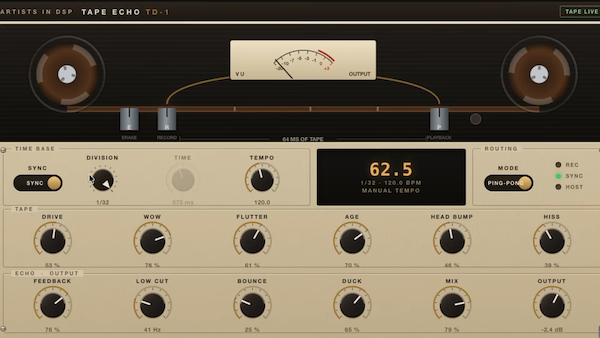
When the idea of vibe coding first started getting talked about a few years ago, being able to build something no one else had felt very exciting. Mass-market instruments and effects require not only a lot of time and effort but also a large enough market to buy them and recoup that effort. With vibe coding, the promise went, you could make whatever suited your individual needs without having to consider a wider customer base.
Enter Artists in DSP’s Amorph, a plugin that lets you vibe code instruments and audio effects inside a DAW. “You describe an instrument or an effect, Amorph writes it and compiles it in your DAW, on the track you have open, and you play it,” explains Leonardo Biasca-Caroni, the co-founder and CEO of Artists in DSP. “If it’s wrong, you say what to change and it compiles again. After that a new idea is a patch inside that, not another plugin.” If you like what you’ve made, you can also share it for other users to try.
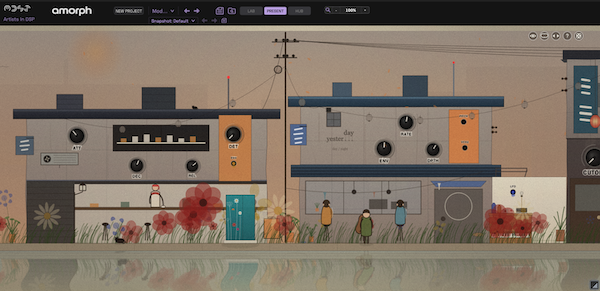
“The example I keep coming back to is Modular Town by Bungle Society,” says Leonardo, by way of explaining what’s possible with Amorph. “He spent roughly four months developing a hand-drawn town containing a semi-modular synth, delay, reverb, sequenced bass and drum machine. The buildings have musical roles and modulation is patched by connecting different parts of the town. The concept grew from his desire to make an instrument that felt like a place rather than a conventional control panel.”
Not everyone, of course, is on board with Amorph. “Some musicians are against anything with AI in it, and they won’t try it whatever we say,” says Leonardo. “A lot of that comes from AI being sold as something that makes the music for you. I understand that. Amorph doesn’t generate music. It generates the instrument. What comes out is your playing.”
Ultimately, Leonardo sees Amoprh as existing alongside plugins from established developers, not as a replacement. “I don’t see prompt-built tools competing with a well-made plugin from a specialist,” he says. “If a finished plugin does the job, buy it. Amorph is for the thing nobody sells, or the thing you want to keep changing.”
Do We Need to Redefine Vibe Coding?
Although it’s easy in theory to dismiss any software made with the help of AI, in reality it may not be that simple, if just because AI is more prevalent in plugins than we may have realized. “It’ll start to be unlikely that you’ll find people making software that has zero AI assistance,” says commenter Andrew in our online poll. “It’s just too useful at finding bugs, filling out some boilerplate or other assistance, even for a coder who’s fully capable of doing everything by hand.”
It may be helpful, then, to redefine what exactly vibe coding means. Does it apply to any AI assistance at all, or rather for software that came out of an AI black box? “Vibe coding for me is more towards the end where AI does most or all of the coding for you – and the result is something that you definitely couldn’t have done yourself and potentially don’t even understand,” writes Andrew.
Jaime of Våld Labs agrees that not all AI usage is the same. “AI is imperfect, and there are legitimate concerns about how it is used,” he says. “But treating every use of AI in creative or technical work as the same thing misses something: a lot of people can now execute ideas that would previously have needed far more money, time or people. Some of those ideas might be genuinely good.”
No matter how we parse it, however, if we keep getting inundated with bad products, the entire industry will suffer. “The problem remains,” sums up Leonardo of Artists In DSP. “If the (developer) doesn’t take the time to get it right, or doesn’t have the skills and the taste to make something that is useful and works well, the plugin will be bad. It was the same when the DAW made recording cheap: a lot more music, most of it not great, and also records that would never have been made otherwise. If the artist has the skills and the taste and stays with it, the plugin can be as good as they are.”
[quote align=right text="AI is imperfect, and there are legitimate concerns about how it is used"]
Some Things to Keep in Mind
We're not saying all plugins created with the help of AI are automatically bad. As we've explored here, there are developers working with AI who are doing good work. But there are some things to keep in mind when purchasing or downloading AI-assisted or AI-made plugins – and going forward, it seems like they will be ever more common.
Do your due diligence. Just like you wouldn't download a dodgy-looking piece of software to your computer for fear of malware, keep security in your mind when choosing plugins. Security issues could be as innocuous (but no less annoying) as instability that leads to crashes, or as frightening as exploitable code that bad actors can take advantage of to deliver malware into your system.
Additionally, are these plugin developers really in it for the long haul? Operating systems are updated nearly constantly. Are they going to keep up with Apple's relentless pace of a new OS every year? When the iPhone first dropped, there was a wealth of music-making apps available. Within a few years, though, most of these were unusable because the people on the other side of the code stopped updating them. Today's vibe-coded plugins could very well be tomorrow's abandonware.
Lastly, CPU optimization is an important thing for DAW-based musicians. The plugin may promise the moon but unless it can deliver that space rock without also taking down your computer in the process, it's basically useless. Only buy vibe-coded plugins with a demo that you can try first.
It's a brave new world out there, and not necessarily one that most of us want. Things will probably shake out to some semblance of normalcy within a few years. Until then, use your best judgment, don't fall for marketing hype, and if it seems shady, it's best to stay away.
[social-links heading="Follow Attack Magazine" facebook="https://www.facebook.com/attackmag" twitter="https://twitter.com/attackmag1" instagram="https://www.instagram.com/attackmag/" youtube="https://www.youtube.com/user/attackmag" soundcloud="https://soundcloud.com/attackmag" tiktok="https://www.tiktok.com/@attackmagazine"] [product-collection]
20