How Do Music Royalties Work? A Complete Breakdown
If you've ever wondered why a DJ's remix blowing up on Spotify doesn't automatically mean they're rich, you're already circling the real question here. How do music royalties work is one of those topics that sounds simple until you try to trace where the money actually goes after a track gets streamed, played on the radio, or synced into a festival aftermovie.
The short answer: royalties are payments split across several distinct streams, each tied to a different use of a song, and each governed by different rights holders, collection agencies, and payout rates. A songwriter, a producer, and a vocalist on the same track can all earn different amounts from the same stream, because they hold different rights. Understanding who pays what and which royalty type applies changes how you negotiate splits, register your work, and read your own statements.
This breakdown walks through the main royalty categories, mechanical, performance, sync, and print, explains who's responsible for paying them, and gives realistic numbers on what artists and songwriters actually earn per stream, per spin, and per sync deal in today's EDM landscape.
Why understanding music royalties matters for EDM artists
EDM runs on collaboration in a way few other genres do. A single festival banger might have a producer building the instrumental, a topline writer handling melody and lyrics, a featured vocalist recording the hook, and a remixer reworking the whole thing six months later for a second life on streaming. Every one of those people has a legal claim to a piece of the royalty pie, but only if their contribution was documented correctly from the start. Royalty splits get decided in the studio, not after the track blows up, and that's exactly when most artists ignore them.
The collaboration problem is bigger in dance music
Ghost production is common in EDM, and it creates a royalty mess that other genres rarely deal with. When a producer builds a track that gets released under a bigger artist's name, the actual songwriter and composer rights don't just disappear, they belong to whoever wrote the music, regardless of whose name is on the release. If that arrangement isn't documented in a work-for-hire agreement or a clear split sheet, the ghost producer can lose out on performance and mechanical royalties for years, even after the track charts. This isn't a hypothetical. Publishers and PROs have handled disputes exactly like this, and they almost always come down to paperwork that should have existed before release day.
If you don't document your splits before release, someone else decides who gets paid after.
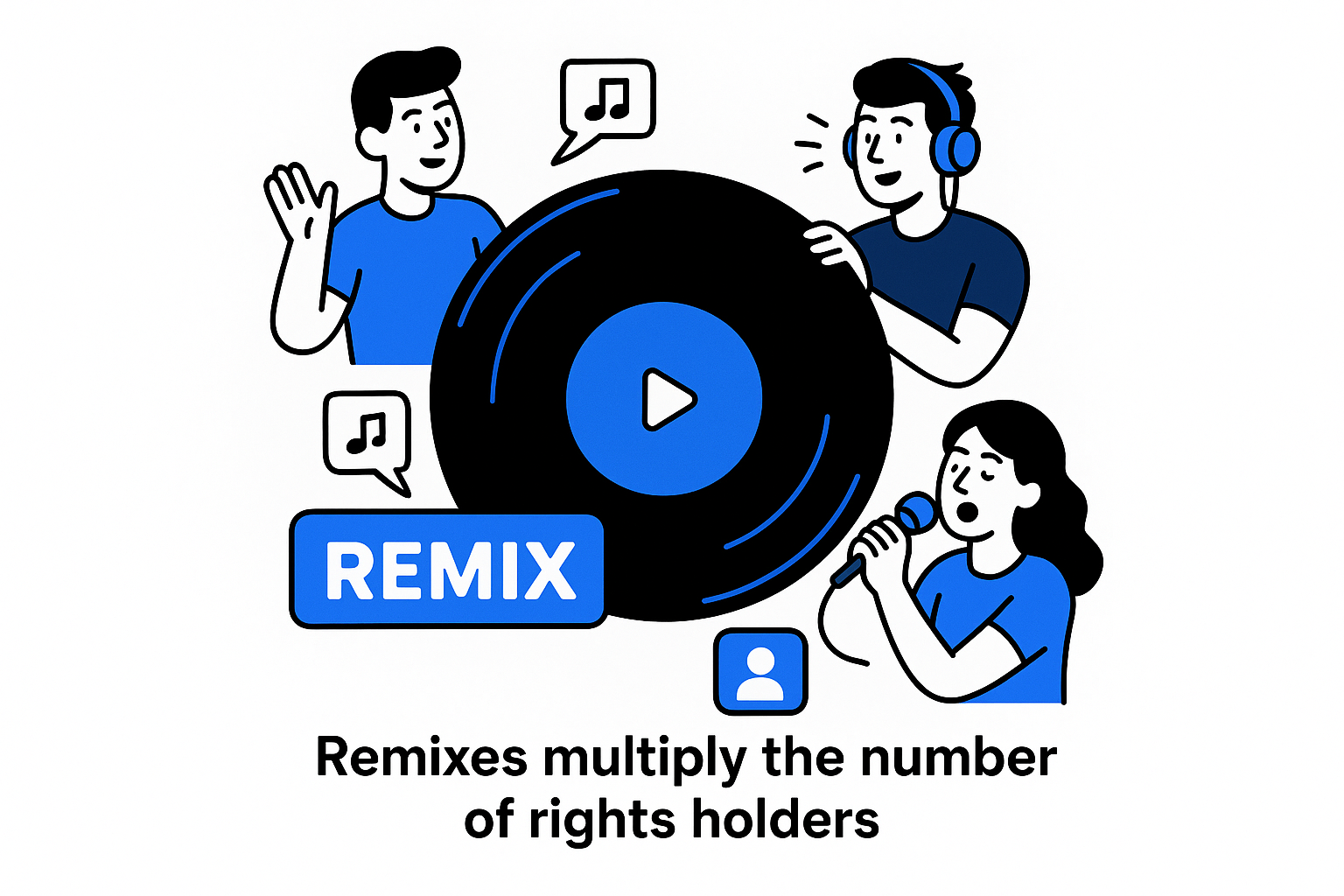
Remixes multiply the number of rights holders
A remix doesn't erase the original songwriter's rights, it stacks a new layer on top of them. The remixer typically earns a producer royalty and sometimes a co-writer credit if they added new melodic or lyrical content, but the original composition owners still collect their share of performance and mechanical royalties every time that remix gets streamed or played out. Here's a simplified look at how royalty claims typically stack on a remixed track:
|
Role
|
Royalty type typically earned
|
Registration needed
|
|
Original songwriter/composer
|
Performance, mechanical
|
PRO registration, publishing admin
|
|
Original producer
|
Master royalty, neighboring rights
|
Label agreement, SoundExchange
|
|
Remixer
|
Producer fee, sometimes co-write
|
Split sheet, remix agreement
|
|
Featured vocalist
|
Performance (as performer), neighboring rights
|
PRO registration, SoundExchange
|
Without clear agreements at each stage, disputes over remix royalties can drag out for months, and streaming platforms won't pause payouts to sort it out for you.
Metadata mistakes cost money quietly
Streaming platforms and PROs match royalty payments to tracks using metadata, the songwriter names, ISRC codes, and publisher splits attached to a release. Incomplete metadata is one of the most common reasons EDM artists never see money they're technically owed. If your name is misspelled, missing a middle initial, or absent entirely from a distributor's upload form, that royalty payment sits in an unclaimed pool, sometimes for years, waiting for someone to file the correct paperwork. Organizations like the U.S. Copyright Office keep public registration records precisely because accurate documentation is what protects your claim when money is on the line, and getting your registration right from day one saves you from chasing unclaimed royalties later.
For EDM artists specifically, where tracks often move fast through collabs, remixes, and label deals, treating royalty structure as an afterthought is the single most common way producers leave money on the table. Get the splits and metadata right before release, and the rest of the royalty system, complicated as it is, actually works in your favor.
How music royalties are calculated and paid out
Most royalty confusion comes down to one fact: nobody pays you directly for a single stream or spin. Instead, money flows through a chain of collectors, aggregators, and distributors before it ever reaches your account, and each stop in that chain calculates its cut differently. Streaming royalties, for example, aren't a fixed rate per play. Platforms pool all subscription and ad revenue for a given month, then divide it based on your share of total streams relative to everyone else's. That's why a track with 500,000 streams on Spotify might earn wildly different amounts depending on how many total streams happened that month and which country the listens came from.
Pro-rata pools decide your per-stream rate
Understanding pro-rata payouts explains why per-stream estimates you see online are only rough averages. A stream in Norway, where subscription prices and revenue per user run higher, pays out more than a stream in a market with lower average subscription pricing. Here's a general sense of the range:
- Spotify: roughly $0.003 to $0.005 per stream
- Apple Music: roughly $0.007 to $0.01 per stream
- YouTube Music: roughly $0.002 to $0.004 per stream
- SoundCloud (monetized/Repost): varies by fan-powered royalty share, often higher for niche EDM audiences
A per-stream rate isn't a fixed number, it's a moving average that shifts every month based on the whole platform's revenue and listening pool.
Payout timelines run slower than most artists expect
Distributors like DistroKid or CD Baby collect from platforms, take their agreed cut or flat fee, then pass the remainder to you, usually 60 to 90 days after the listening period closes. Performance royalties from PROs like ASCAP or BMI run even slower, often landing six months to a year after a track gets played, because PROs batch-process massive volumes of usage data before calculating shares. Mechanical royalties, collected through The MLC in the US, follow a similar quarterly cycle tied to reported streaming and download activity.
Splits determine who gets what before payout even happens
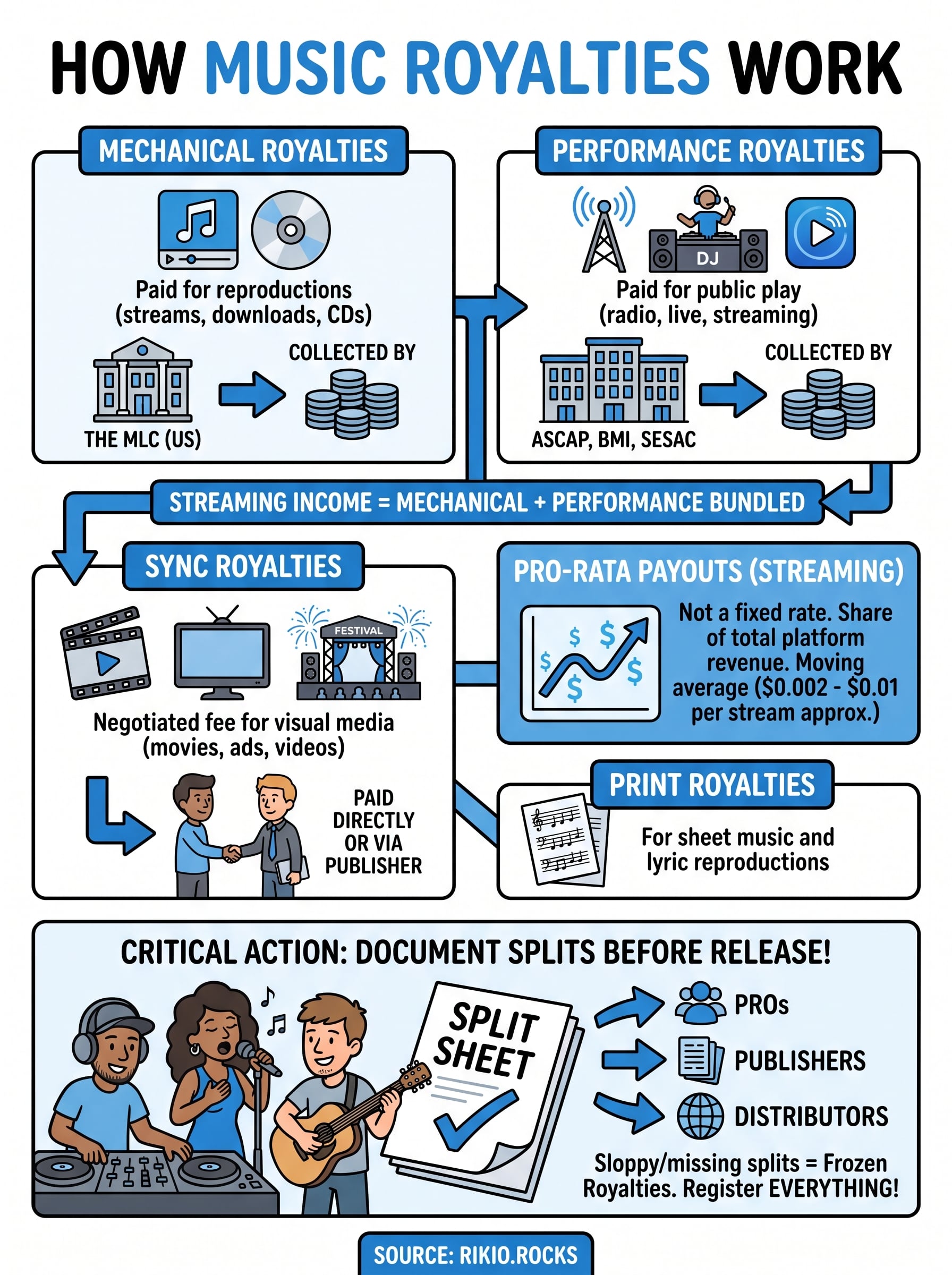
Before any of that money reaches an individual, it gets divided according to registered ownership splits. If three writers agreed to a 40/30/30 split on a track, the distributor or PRO pays out exactly that ratio, assuming the split sheet was filed correctly. Sloppy or missing splits don't just delay payment, they can freeze it entirely until the dispute gets resolved, which is another reason getting the paperwork right before release matters more than chasing streams after the fact.
The main types of music royalties explained
Four royalty categories cover almost every way a song generates money, and knowing which one applies to a given use is the core of how do music royalties work. Mechanical royalties get paid whenever a song gets reproduced, whether that's a physical copy, a download, or a stream. Performance royalties get paid whenever a song gets played publicly, on radio, in a club, or through a streaming service's public performance component. Sync royalties get negotiated whenever a song gets paired with visual media, like a festival aftermovie or a brand campaign. Print royalties, the smallest category for most EDM artists, cover sheet music and lyric reproductions.
Mechanical and performance royalties carry the most weight
Streaming blends both mechanical and performance royalties into a single payout, which confuses a lot of artists who assume streaming income is one simple category. The MLC handles mechanical collection for interactive streams in the US, while PROs like ASCAP, BMI, and SESAC handle the performance side. Radio play, satellite radio, and background music in venues generate performance royalties exclusively, since no reproduction happens.
Streaming income isn't one royalty, it's two different royalty types bundled into a single payment.
Sync deals and neighboring rights fill in the gaps
Sync licensing works differently from the other categories because it gets negotiated directly, not calculated through a formula. A festival wanting to use your track in a recap video pays a flat, negotiated fee split between the songwriter and the master owner, and that fee can range from a few hundred dollars for a small YouTube channel to five figures for a major brand campaign. Neighboring rights, collected in the US through SoundExchange, cover performers and master owners when a recording gets played on non-interactive platforms like satellite radio or Pandora.
|
Royalty type
|
Triggered by
|
Who collects it
|
|
Mechanical
|
Reproduction, downloads, interactive streams
|
The MLC (US)
|
|
Performance
|
Public play, radio, streaming's public performance share
|
ASCAP, BMI, SESAC
|
|
Sync
|
Pairing music with video or media
|
Negotiated directly or via publisher
|
|
Neighboring rights
|
Non-interactive digital play
|
SoundExchange
|
Each category runs through its own collection system, on its own timeline, at its own rate. Missing a registration with even one of these organizations means leaving that entire royalty stream uncollected, no matter how well the rest of your paperwork is handled.
Who pays royalties and who actually gets paid
Money for music royalties originates from whoever uses the song commercially: streaming platforms, radio stations, festival promoters, brands, and venues. But the person writing that check almost never pays the artist directly. Instead, payments route through collection societies, distributors, and publishers, each taking a processing cut before the remainder lands in an artist's account. That layered structure is exactly why understanding how do music royalties work requires knowing both sides of the transaction, not just the payout number at the end.
The paying side covers more ground than most artists assume
Every entity that plays, reproduces, or licenses a song owes money to someone. Here's a breakdown of who's actually cutting checks:
- Streaming platforms (Spotify, Apple Music, SoundCloud) pay distributors and PROs based on stream counts
- Radio and satellite services pay PROs and SoundExchange for performance and neighboring rights
- Festival organizers and brands pay negotiated sync fees directly to publishers or master owners
- Venues and clubs pay blanket licensing fees to PROs for any music played live or over a sound system
- Physical and digital retailers pay mechanical royalties through the MLC for reproductions sold
The receiving side splits into rights holders, not just artists
On the collecting end, money doesn't go straight into a producer's pocket. It passes through PROs, publishers, and distributors who verify ownership splits before releasing funds. Songwriters and composers collect through their PRO and publisher. Master owners, usually the artist or label who paid for the recording, collect mechanical and neighboring rights through SoundExchange and the MLC. Featured performers collect a separate neighboring rights share, even if they didn't write a note of the song.
The people who use your music and the organizations that pay you are rarely the same entity, which is why registration determines whether you get paid at all.
Registering with every relevant body, your PRO, a publishing administrator, SoundExchange, and the MLC, closes the gap between who owes you money and who actually sends it. Skip one, and that royalty stream sits uncollected no matter how many times your track gets played.
Real-world royalty examples from the EDM scene
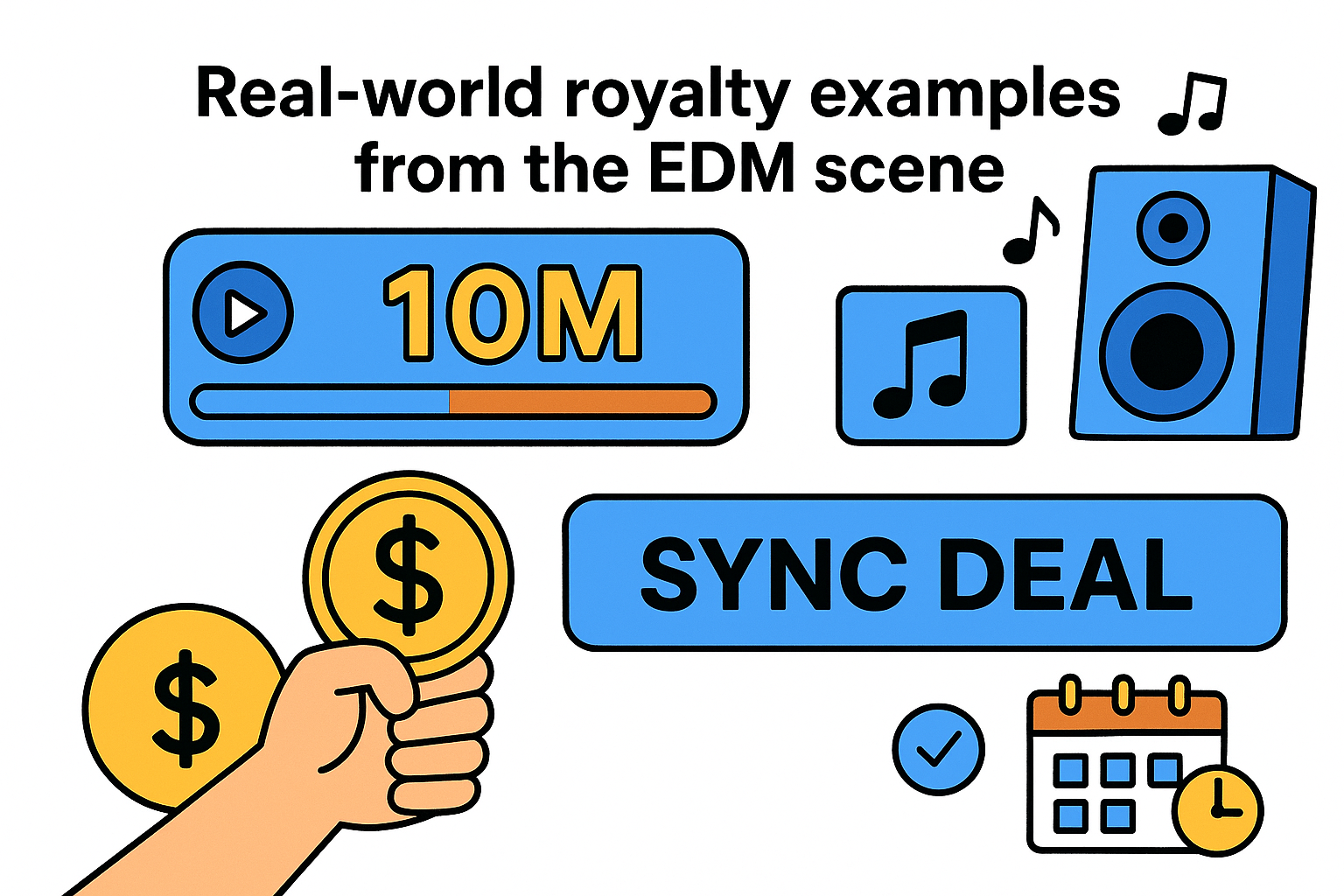
Numbers stop feeling abstract once you attach them to a track people actually know. Picture a progressive house remix that racks up 10 million Spotify streams in its first year. At a blended rate of roughly $0.004 per stream, that's around $40,000 total, but it doesn't land in one pocket. The original songwriter collects a mechanical and performance share through the MLC and their PRO, the master owner collects the rest as label or distribution revenue, and if the remixer added new melodic content, they carve out a producer or co-write percentage before anyone else sees a cent.
A festival sync deal shows how fast money moves outside streaming
Compare that to a mid-size festival licensing a track for its official aftermovie. Instead of waiting on pooled streaming revenue, the publisher negotiates a flat sync fee, often somewhere between $500 and $5,000 depending on the festival's size and how prominently the track features. That fee gets split between the songwriter's publishing side and the master owner, and it usually pays out within weeks, not months. It's one of the few royalty types where an EDM artist sees real money almost immediately.
A single sync placement can pay out faster and more predictably than a million streams ever will.
A collaborative release shows why splits matter before drop day
Now take a track built by three people: a producer, a topline writer, and a featured vocalist, released independently through a distributor. Here's a realistic breakdown of a $10,000 total royalty pool earned across streaming, sync, and radio over a year:
|
Contributor
|
Role
|
Royalty share
|
Approx. payout
|
|
Producer
|
Master owner, composer
|
45%
|
$4,500
|
|
Topline writer
|
Co-composer, lyricist
|
35%
|
$3,500
|
|
Featured vocalist
|
Performer, neighboring rights
|
20%
|
$2,000
|
That split only works cleanly because the three parties filed a split sheet before release. Without it, the distributor and PRO have no basis for dividing payment, and disputes like this routinely freeze royalties for months while the parties sort out who owns what. These examples all point to the same lesson: the royalty type determines the timeline and size of payment, but the paperwork determines whether you see any of it at all.
Staying on top of your music royalties
At its core, how do music royalties work comes down to one habit: documenting everything before release, not chasing payments after the fact. Mechanical, performance, sync, and neighboring rights all move through different systems on different timelines, but every single one depends on accurate splits and registrations filed early. Skip that step, and even a track with millions of streams can sit on unclaimed money for years.
Treat your paperwork the way you treat your mix, something you finish before drop day, not after. Register with your PRO, publisher, SoundExchange, and the MLC, keep split sheets on file for every collaborator, and check your statements regularly instead of assuming the system caught everything correctly.
While you're sorting out the business side, keep the creative energy going too. Press play on our CARDIO HITS 2026 Playlist and let the tracks that pay artists fairly power your next workout.
133