8 Best Studio Monitors For Mixing EDM (2026 Picks)
You can't mix a drop that hits right if your monitors are lying to you. Cheap or mismatched speakers hide bass buildup, mask harsh highs, and make every EDM track sound better in your room than it does everywhere else. That's the trap most home producers fall into, and it's why finding the best studio monitors for mixing matters more than another plugin or sample pack.
This guide skips the vague marketing copy and gets straight to what matters for electronic music: accurate low-end reproduction for kicks and sub-bass, honest frequency response across the mids and highs where synths and vocals live, and enough headroom to handle loud sessions without breaking up. We tested and researched options across price points, from bedroom-producer budgets to serious project studios.
Below you'll find eight monitors worth your money in 2026, picked with EDM workflows in mind, whether you're producing in a small apartment or a treated room. We cover room size compatibility, wattage, and what genre-specific quirks to watch for, so you leave with a shortlist instead of forty open browser tabs.
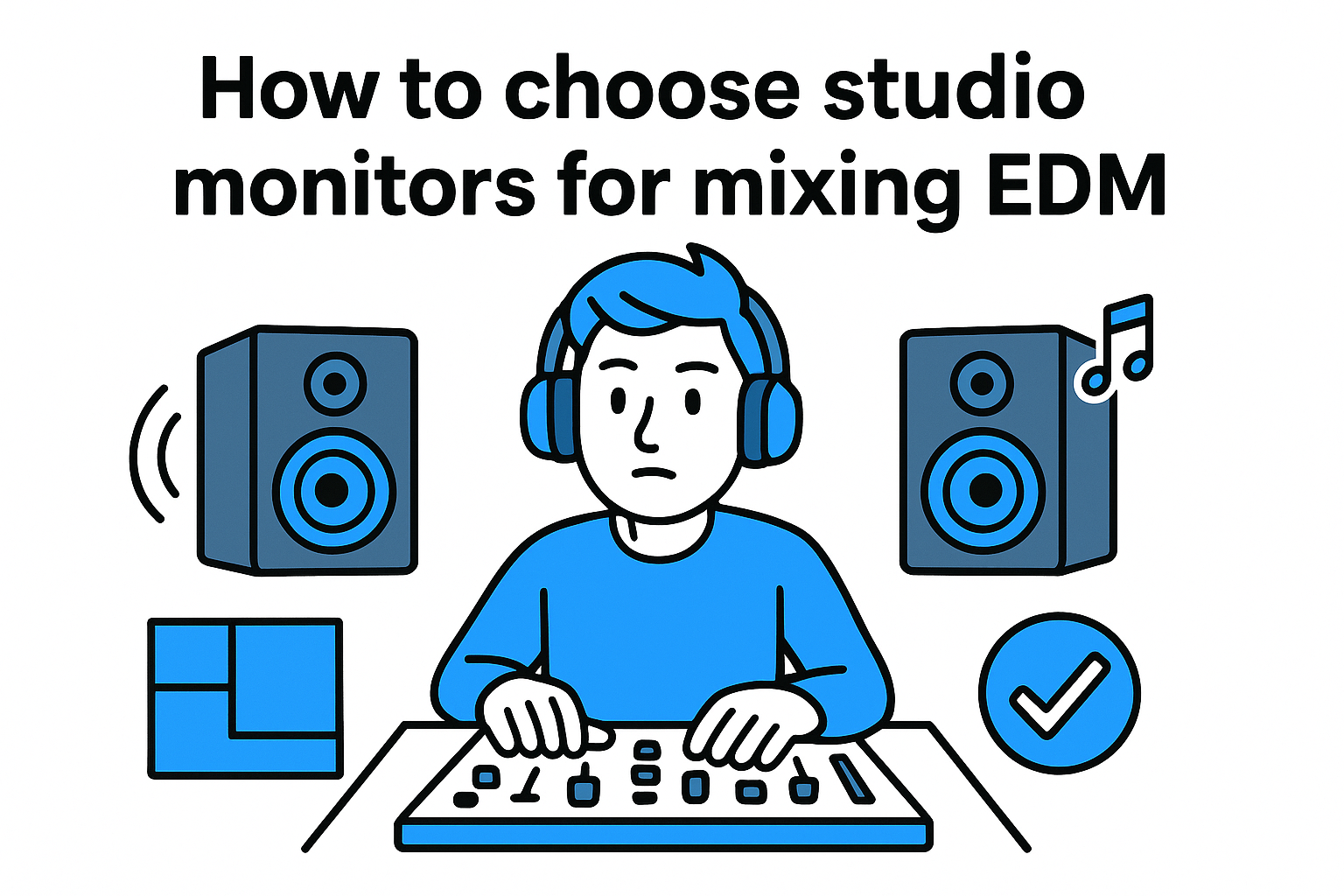
1. How to choose studio monitors for mixing EDM
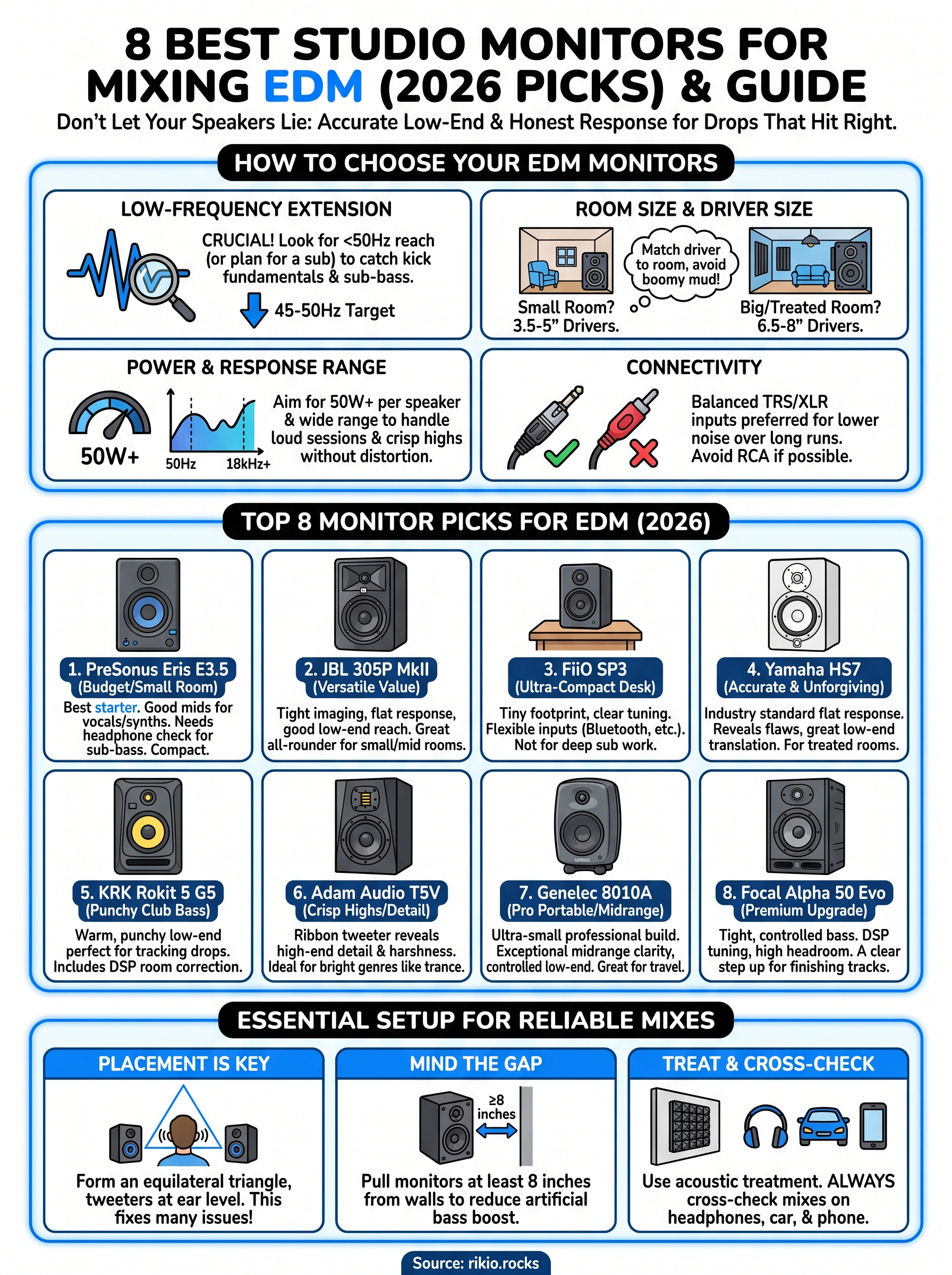
EDM lives and dies by its bass. Before you look at any specific model, understand that low-frequency extension matters more here than in almost any other genre. A monitor that rolls off at 60Hz will lie to you about sub-bass and 808s, and you'll overcompensate by boosting frequencies that were already fine. Look for monitors rated down to at least 45-50Hz if you can't afford a subwoofer, since that range covers most kick fundamentals and low bass notes producers actually work with.
Room size dictates driver size, and this trips up more bedroom producers than any other decision. A 8-inch woofer in a 10x10 room will excite every mode in the space and give you a boomy, unreliable picture of your low end. Smaller rooms, generally anything under 150 square feet, do better with 3.5 to 5-inch drivers. Bigger, treated rooms can handle 6.5 to 8-inch monitors without the bass turning to mud.
The best monitor for your mix is the one that tells you the truth about your room, not the one with the biggest number on the spec sheet.
Power ratings and frequency response range tell you how loud you can push a monitor before it distorts and how wide a slice of the spectrum it covers accurately. For EDM, aim for at least 50 watts per speaker for near-field listening, and check that the response range extends comfortably below 50Hz and above 18kHz to catch the shimmer in synth leads and hi-hats. Don't just trust the marketing spec sheet, though. Read independent measurements when you can find them.
Connectivity matters more than people expect. Most home studios run balanced TRS or XLR from an audio interface, so confirm your monitors accept those inputs before ordering. Cheaper models sometimes only offer unbalanced RCA, which picks up more noise over longer cable runs.
Finally, think about your actual workflow. Are you mixing on headphones half the time and monitors the other half? Do you need a subwoofer eventually? Answering these questions now saves you from buying twice.
2. PreSonus Eris E3.5 for budget EDM mixing
The Eris E3.5 is the monitor most bedroom producers start with, and for good reason. It costs less than a decent MIDI controller, yet it gives you a far more honest picture of your mix than laptop speakers or gaming headsets ever will. PreSonus built this pair specifically for tight spaces, and it shows in every design choice.
Sound signature and bass response
Don't expect deep sub-bass from a 3.5-inch woofer. The frequency response sits at 80Hz to 20kHz, which means your 40-50Hz kick fundamentals won't show up accurately. What you do get is a clean, forward midrange that makes vocal chops and lead synths easy to place. Pair it with headphones for low-end checks and you'll avoid most surprises.
Power and size considerations
Each speaker runs on 25 watts, enough for near-field listening in small rooms without distortion at normal mixing volumes. The compact cabinet fits on cramped desks where larger monitors simply won't.
Connectivity options
You get balanced 1/4-inch TRS and unbalanced RCA inputs, plus a front-panel headphone jack and volume knob. That flexibility covers most beginner interface setups without extra adapters.
A monitor this cheap won't replace a subwoofer, but it will teach you to trust your ears over your room.
Who it's best for
This pair suits total beginners working in small apartments or dorm rooms who need an honest step up from consumer speakers without a big financial commitment.
3. JBL 305P MkII for versatile nearfield mixing
The JBL 305P MkII sits in that sweet spot where price stops being an excuse. JBL borrowed its Image Control Waveguide from studio monitors costing three times as much, and the result is a speaker that images tightly enough to hear exactly where your reverb tails and side-chained pads sit in the stereo field. It's become a default recommendation for a reason.
Sound signature and bass response
Expect a flatter response than most monitors at this price, rated from 49Hz to 20kHz. That low-end reach matters for EDM, since it captures more of your kick and bass fundamental without a subwoofer. Highs stay detailed without turning harsh during long mixing sessions, which helps when you're dialing in bright supersaws or crisp hi-hat patterns.
Power and size considerations
Each cabinet packs 41 watts of Class D amplification driving a 5-inch woofer, giving you enough headroom for near-field listening at realistic mixing volumes. The size works well in small to mid-size rooms, roughly 100 to 200 square feet, without overwhelming the space.
Balanced imaging and honest bass extension are why the 305P MkII outperforms speakers twice its price.
Connectivity options
You get balanced XLR and TRS combo inputs, plus a rear-panel input sensitivity switch to match different interface output levels. No RCA option here, which pushes you toward a cleaner, more professional signal chain from the start.
Who it's best for
Producers ready to move past starter monitors, especially those mixing EDM in a small studio without room treatment yet, will get the most value from this pair.
4. FiiO SP3 for compact desks with big sound
The FiiO SP3 surprises people who assume a budget-friendly Chinese audio brand can't compete in the studio monitor space. FiiO built its reputation on headphone amps and DACs, and that DNA shows up here as a monitor tuned for clarity rather than hype. It's a solid pick if your desk barely fits a keyboard, let alone a pair of full-size monitors.
Sound signature and bass response
The frequency response runs from 65Hz to 20kHz, giving you slightly more low-end reach than the Eris E3.5 despite the similar footprint. The tuning leans neutral rather than bass-heavy, so kick drums and bass synths sit where they actually belong instead of sounding inflated.
Power and size considerations
Each speaker delivers 24 watts through a 3-inch driver, plenty for close-range listening in rooms under 100 square feet. The compact wooden cabinet looks and feels sturdier than most speakers this size.
Connectivity options
You get RCA, 3.5mm aux, optical, and Bluetooth inputs, which makes this one of the most flexible monitors on this list for mixed-use setups. That said, the lack of balanced XLR or TRS inputs means dedicated studio work still favors the JBL or PreSonus.
Connectivity flexibility like this makes the SP3 as much a desktop hi-fi speaker as a mixing tool.
Who it's best for
Producers with extremely tight desk space, or anyone who wants one speaker pair for both casual listening and light mixing work, will appreciate this pair most.
5. Yamaha HS7 for accurate low-end translation
The Yamaha HS7 carries a reputation that stretches back to the original NS-10, the monitor that shaped how a generation of engineers heard bass. Yamaha kept that honest, slightly unforgiving character alive in the HS series, and producers still reach for it when they need to know exactly what their low end will sound like on a club system.
Sound signature and bass response
Expect a flat, uncolored frequency response rated from 43Hz to 30kHz, among the widest ranges on this list. That extension down to 43Hz means kick drums and sub-heavy 808s translate with far less guesswork than smaller monitors allow. The tuning stays neutral rather than flattering, so weak spots in your mix show up immediately instead of hiding behind a pleasant curve.
Power and size considerations
Each cabinet houses 60 watts driving a 6.5-inch woofer, giving you real headroom for near-field listening in rooms between 150 and 250 square feet. A rear-panel port and room control switch help tame bass buildup against walls, a common problem in untreated bedrooms.
Flat and unforgiving beats flattering when your job is finding problems before your listeners do.
Connectivity options
You get balanced XLR and TRS combo inputs, plus low-cut and high-trim EQ switches for basic room correction. No unbalanced RCA option exists, which keeps the signal path clean for serious mixing.
Who it's best for
Producers with a dedicated, semi-treated room who want reference-grade accuracy for finishing club-ready low end will get the most out of this pair.
6. KRK Rokit 5 G5 for punchy club-ready bass
The KRK Rokit 5 G5 is the monitor you've seen in a thousand studio photos, and it earned that reputation by tuning itself specifically for bass-heavy genres. KRK built its name on hip-hop and EDM production, and the fifth-generation Rokit refines that formula with a new woofer material and DSP-driven room correction that older versions lacked.

Sound signature and bass response
This pair leans warmer than the Yamaha or JBL, with a frequency response rated from 43Hz to 40kHz. The low end punches harder than the spec sheet suggests, which flatters kicks and 808s but can trick you into under-mixing bass if you don't cross-check on flatter monitors. That extra low-end energy is exactly why club and festival producers gravitate toward this pair.
Bass that flatters your ears can still betray your mix, so pair the Rokit's punch with a second reference point.
Power and size considerations
Each cabinet runs 105 watts total through a 5-inch Kevlar woofer, giving you serious headroom for near-field listening in rooms up to 200 square feet. Built-in DSP room correction, adjustable through a companion app, helps tame boundary bass buildup in smaller spaces.
Connectivity options
You get balanced XLR and TRS combo inputs alongside USB connectivity for the room correction app. No RCA input exists here, keeping the signal path clean for serious production work.
Who it's best for
EDM and hip-hop producers who want an energetic, club-ready low end for tracking drops and basslines will feel right at home with this pair.
7. Adam Audio T5V for crisp high-frequency detail
The Adam Audio T5V carries the same U-ART ribbon tweeter tech that made Adam's flagship monitors famous, shrunk down into a price tag most home producers can actually afford. That tweeter design pushes air differently than a standard dome, giving you a clarity in the upper frequencies that helps you catch harsh resonances in supersaws before they ruin a drop on a club system. If you've ever finished a mix that sounded fine at home but turned brittle everywhere else, this is the kind of monitor built to fix that problem.
Sound signature and bass response
High-frequency detail defines this pair more than low end does. The frequency response runs from 45Hz to 25kHz, respectable for a 5-inch woofer, but the real story sits above 10kHz, where the ribbon tweeter reveals sibilance and cymbal detail other monitors smear together.
Among the best studio monitors for mixing bright, detail-heavy EDM elements, the T5V earns its reputation in the top end, not the bottom.
Power and size considerations
Each cabinet delivers 50 watts through its woofer and 20 watts to the tweeter, giving enough headroom for rooms between 100 and 180 square feet without strain.
Connectivity options
You get balanced XLR and TRS combo inputs, plus rear-panel EQ switches for shelf and desktop adjustments. No RCA input exists, keeping the signal path clean.
Who it's best for
Producers who mix bright, detail-heavy EDM subgenres, like trance or progressive house, will value this pair's top-end honesty most.
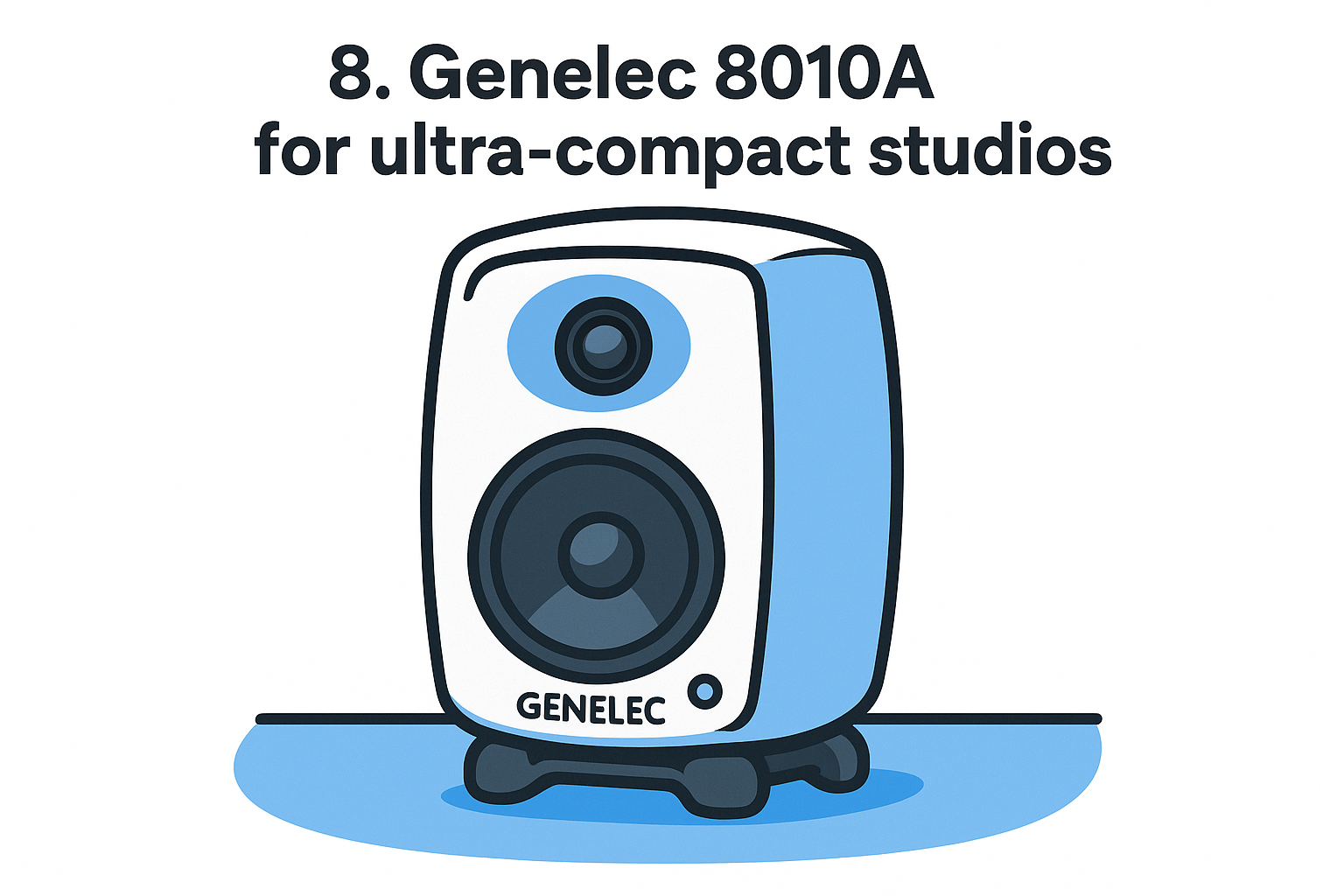
8. Genelec 8010A for ultra-compact studios
The Genelec 8010A proves that Finnish engineering can shrink a serious studio monitor down to the size of a coffee mug without gutting its performance. Genelec built its reputation on broadcast and mastering-grade monitors, and the 8010A carries that same die-cast aluminum enclosure and Minimum Diffraction Coefficient waveguide into a footprint small enough for a laptop bag. It's the pick for producers who travel or work in genuinely tiny rooms.
Sound signature and bass response
Don't expect deep sub-bass here. The frequency response runs from 67Hz to 25kHz, so kick fundamentals below 60Hz need a subwoofer or headphone check. What you get instead is exceptional midrange clarity and a tight, controlled low end that never overstates itself, which matters when you're second-guessing bass decisions on a small speaker.
Small monitors like the 8010A trade sub-bass reach for honesty everywhere else, and that trade often pays off in a tiny room.
Power and size considerations
Each cabinet packs 25 watts through a 3-inch woofer, plenty for close-range listening in rooms under 100 square feet or even on a single desk with minimal spacing.
Connectivity options
You get balanced XLR input only, no RCA or TRS, which keeps noise out but requires a proper audio interface.
Who it's best for
Producers working in extremely small rooms, closets, or mobile setups who still want accurate mids and highs will value this pair most.
9. Focal Alpha 50 Evo for a premium upgrade
The Focal Alpha 50 Evo sits at the top of this list for producers ready to stop upgrading and start finishing tracks. Focal built its name on high-end car audio and reference monitors, and the Evo generation brings that pedigree down to a price still reachable for a serious home studio. If you've outgrown the JBL or Yamaha and want a clear step up rather than a lateral move, this is where you land.
Sound signature and bass response
The frequency response runs from 45Hz to 22kHz, backed by Focal's own Tuning Mode DSP that lets you correct for wall placement and desk reflections. Bass stays tight and controlled rather than exaggerated, which makes it easier to judge whether your 808s and sub layers actually sit right without a subwoofer.
A monitor that corrects for your room, not just your ears, saves you from mixing decisions you'll regret on a club system.
Power and size considerations
Each cabinet delivers 100 watts total through a 5-inch woofer, giving serious headroom for rooms up to 200 square feet. The die-cast aluminum enclosure reduces cabinet resonance that plagues cheaper plastic monitors.
Connectivity options
You get balanced XLR and TRS combo inputs, plus rear-panel switches for Tuning Mode adjustments. No RCA input exists here, keeping the signal chain professional.
Who it's best for
Producers ready to invest in a lasting reference pair, especially those finishing club and festival releases, will get the most value from this upgrade.
10. Setting up your monitors for reliable EDM mixes
Buying the best studio monitors for mixing won't fix a bad setup. Placement matters as much as the speaker itself, and most home producers get it wrong by pushing monitors against a wall or angling them incorrectly. Form an equilateral triangle between your ears and each speaker, with the tweeters at ear height. That alone fixes more mixing problems than any EQ plugin.
Distance from walls changes your bass response more than people expect. Boundary reinforcement, the bass boost that happens when a monitor sits too close to a wall or corner, can add several dB of low end that isn't really there. Pull your monitors at least 8 inches from the back wall, and use the room-control switches many monitors on this list include to compensate further.
Perfect placement can matter more than a monitor upgrade, since even great speakers lie in the wrong spot.
Room treatment doesn't need to be expensive. Foam panels at first reflection points, the spots on side walls and ceiling where sound bounces before reaching your ears, cut smearing that muddies transients and hi-hats. A rug on hard floors helps too.
Cross-checking remains non-negotiable for EDM specifically. Reference your mix on headphones, in your car, and on a phone speaker before calling it finished. Sub-bass especially needs this step, since even excellent monitors like the Yamaha HS7 can't replace a proper club system for confirming how deep bass will actually hit.
Finding the right monitors for your setup
Your room size and budget decide more than any spec sheet ever will. A treated studio space can handle the Yamaha HS7 or Focal Alpha 50 Evo, while a bedroom desk does better with the FiiO SP3 or Genelec 8010A. Match the monitor to where you actually work, not where you wish you worked.
Bass accuracy separates a mix that translates from one that falls apart on a club system. Whichever pair you pick from this list, cross-check on headphones and in your car before calling anything finished. That habit matters more than any single speaker upgrade.
Once your monitors tell the truth about your low end, trust your ears and finish the track. Then throw it on a system built for pounding bass and driving rhythm to see how those kicks and drops actually hit. Test your next finished mix against our CARDIO HITS 2026 playlist and hear how it stacks up.
9