DJ Mix Equipment: 7 Essentials for Your First Setup
You want to start mixing, but the gear wall at every music store looks like a cockpit. Cables, jacks, knobs, and three different formats that all claim to be what every DJ uses. That confusion stops a lot of beginners before they cue up their first track, and it's exactly why picking the right dj mix equipment matters more than any tutorial on blending two songs.
Here's the short answer: you need a handful of core pieces, not a studio's worth of gear. A dj controller or turntable setup, a mixer, monitors or speakers, headphones, and software form the backbone of nearly every rig, from bedroom sets to festival stages. Once you know what each piece actually does, the shopping list stops feeling random and starts making sense.
This list breaks down the seven essentials you need for a first setup that won't leave you re-buying gear six months in. We'll cover dj equipment for starters at every budget, what separates a decent mixer from a cheap one, and where RIKIO ROCKS sees working DJs actually spend their money. By the end, you'll know exactly what to buy and what you can skip for now.
1. DJ controller
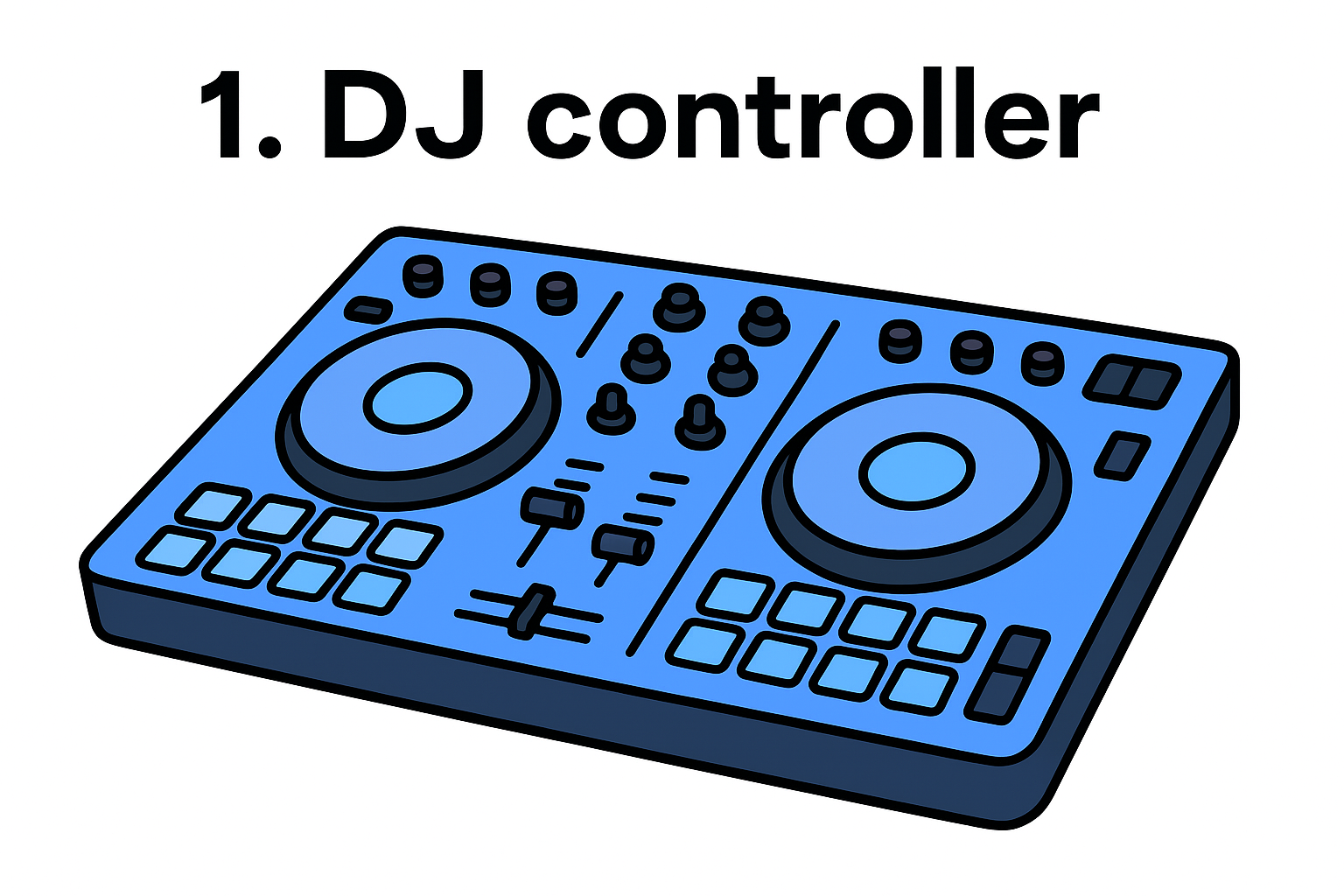
A DJ controller is the single piece of dj mix equipment that replaces a mixer, two decks, and a sound card all in one box. It plugs straight into your laptop, sends MIDI signals to software like Serato or rekordbox, and lets you jog, cue, loop, and crossfade without owning a single vinyl record. For anyone comparing dj equipment for starters, this is almost always where the search ends up, because one purchase gets you mixing the same night it arrives.
What it does
Think of the controller as the steering wheel for your software. Jog wheels scrub through tracks, pad grids trigger hot cues and loops, and the built-in mixer section handles EQ, filters, and the crossfader. Everything you'd do on club-standard turntables and a mixer, a controller condenses into one deck you can carry in a backpack.
Who it's for
Beginners benefit most, but so do mobile DJs who need gear that packs down fast for weddings and bars. If you're still deciding whether DJing is a hobby or a habit, a controller lets you find out without the cost of separate club gear.
A controller is the fastest, cheapest way to find out if you actually like DJing.
What to look for
-
Two channels minimum, four if you plan to mix in extra tracks or samples later
- Full-size, weighted jog wheels rather than tiny plastic ones
- Software compatibility, since some units lock you into one brand of dj mixing equipment ecosystem
- Built-in audio interface so you don't need a separate sound card
- USB-powered options if you'll travel light
Typical price range
Entry-level two-channel controllers start around $150 to $250. Mid-range four-channel units with better build quality and pad feel run $400 to $700. Club-ready controllers built for professional sets, like Pioneer DJ's flagship models, push past $1,000.
2. Headphones for DJing
Headphones are the second half of every dj mixer equipment setup, and they matter more than most beginners assume. You use them to cue up the next track in your ear while the crowd hears the current one through the speakers, so weak headphones make beatmatching and transitions genuinely harder than they need to be.
What it does
Your headphones let you preview a track before it hits the mix. You split your hearing between one ear on the live output and one ear on the cued track, lining up the beat before you bring it into the room. Cheap earbuds can't isolate sound well enough to do this reliably in a loud venue.
Bad headphones don't just sound worse, they make you mix worse.
Who it's for
Every DJ needs a pair, no exceptions. Bedroom producers can get away with less isolation, but anyone playing bars, clubs, or parties needs headphones built to cut through loud rooms.
What to look for
-
Closed-back design for sound isolation in loud venues
- A swiveling ear cup so you can monitor with one ear
- Coiled cables that resist tangling and stretch
- Comfortable padding for multi-hour sets
Typical price range
Solid entry-level DJ headphones run $50 to $100. Pro-grade pairs from Sennheiser or Pioneer DJ land between $150 and $300.
3. Laptop and DJ software
Your laptop is the brain of the whole rig. It runs the software that reads your music library, syncs with your controller, and outputs sound through your speakers or headphones. Without it, even the best dj mixing equipment on your desk is just plastic and knobs.
What it does
DJ software like Serato DJ Pro, rekordbox, or Virtual DJ handles the actual audio processing, waveform display, and library organization. Your laptop translates the physical movements on your controller into what you hear, applying EQ, effects, and time-stretching in real time.
Who it's for
Almost every modern DJ needs this combo, whether you're mixing MP3s at home or running a full club set. Standalone gear exists, but most beginners learn on laptop-based software because it's cheaper to update and easier to troubleshoot.
Your laptop only needs to be reliable, not powerful.
What to look for
- At least 8GB of RAM and an SSD for smooth performance
- A dedicated USB port that won't conflict with your controller
- Software that matches your controller's brand for full compatibility
- Battery life rated for at least a two-hour set
Typical price range
A budget laptop capable of running DJ software costs $500 to $800. Most DJ software is free with a controller purchase, though pro tiers of Serato or rekordbox run $10 to $20 monthly.
4. Studio monitors or PA speakers
Speakers are where your mix actually leaves the laptop and hits the room. As part of your dj mix equipment, monitors or PA speakers translate the signal from your mixer into sound you and your audience can actually hear and react to, and cheap laptop speakers simply can't handle bass frequencies well enough to mix accurately.
What it does
Studio monitors give you a flat, honest frequency response so you can hear how a track actually sounds, not a flattering version of it. PA speakers, on the other hand, are built to fill a room or a backyard party with volume and punch. Both convert your mixer's output into audible sound, but they're tuned for different jobs.
Who it's for
Bedroom DJs and producers should start with a pair of studio monitors for accurate mixing at home. Mobile DJs playing parties or small venues need PA speakers that can actually project over a crowd.
You can't mix well if you can't trust what you're hearing.
What to look for
-
Active (powered) speakers so you skip buying a separate amplifier
- Balanced XLR or TRS inputs for clean signal from your mixer
- Wattage matched to your room size, not maxed out for no reason
- A frequency response low enough to actually hear your bass
Typical price range
A basic pair of active studio monitors runs $100 to $250. Compact PA speakers capable of covering a small event start around $300 and climb past $600 for a pair with real headroom.
5. DJ mixer
A standalone DJ mixer takes over once you move away from an all-in-one controller and want separate turntables or CDJs. It blends the signal from each source, handles EQ and crossfading, and sends a single clean output to your speakers. For anyone shopping for equipment for dj work beyond the bedroom, this is the piece that turns two separate decks into one coherent mix.
What it does
The mixer sits between your turntables or CDJs and your speakers, combining channels, shaping tone with EQ, and letting you crossfade between tracks smoothly.
A mixer is what turns two separate players into one continuous set.
Who it's for
DJs running club-style setups with turntables or CDJs need a dedicated mixer. Controller users don't need one right away since the mixing section is already built in.
What to look for
-
Channel count matching your number of players, usually two or four
- Onboard effects like echo and filter for creative transitions
- Solid build quality on the crossfader, since it wears out fastest
- Phono and line inputs to support both vinyl and digital sources
Typical price range
Basic two-channel mixers start around $150. Club-standard mixers from brands like Pioneer DJ or Allen & Heath run $500 to $1,200.
6. Turntables and CDJs
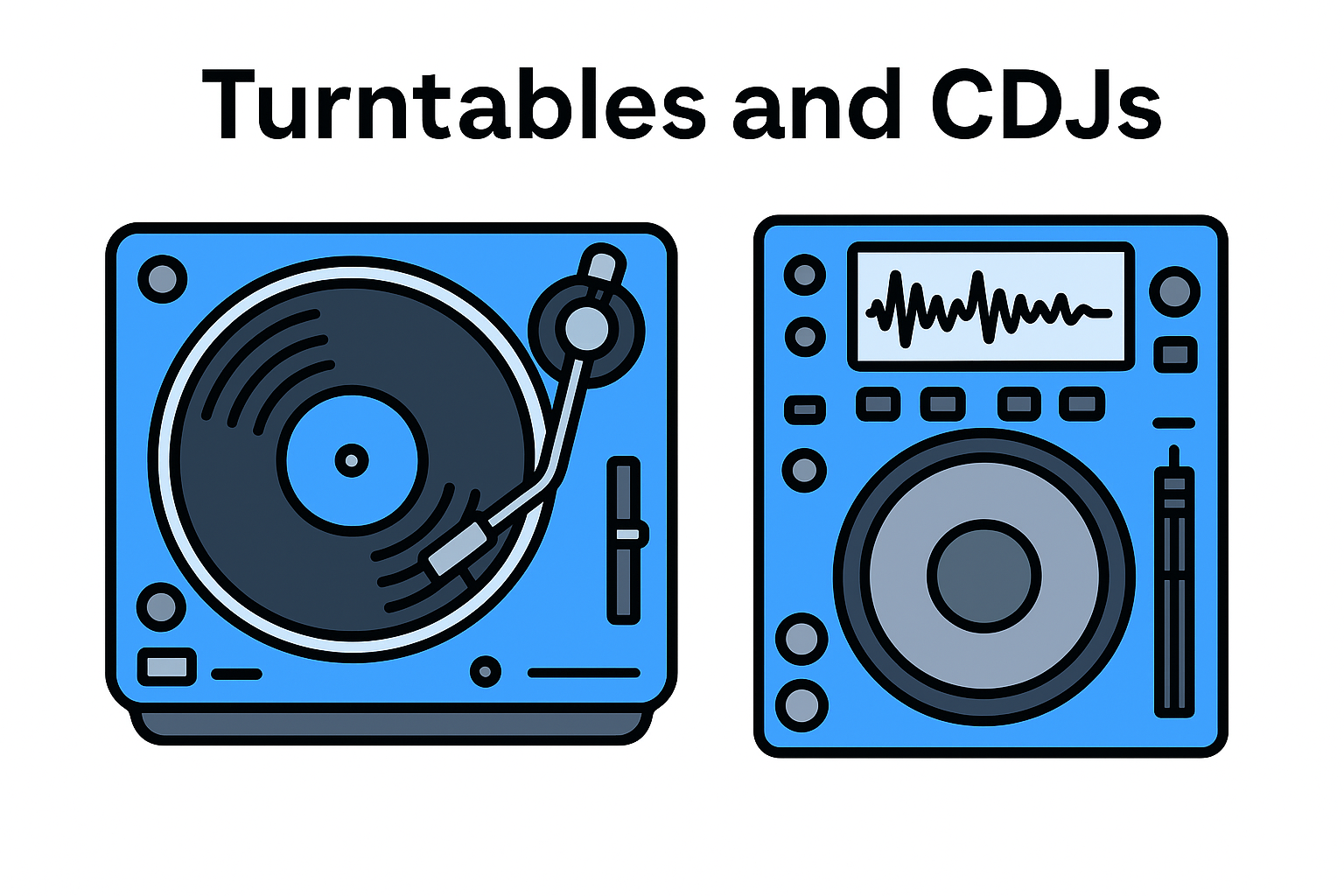
Turntables and CDJs are the source players that feed your mixer, and they're what most people picture when they think of professional dj equipment. Vinyl turntables spin physical records, while CDJs read digital files off USB drives, but both do the same job: putting audio into the mixer for you to blend.
What it does
Each deck plays one track at a time, and you use pitch faders, jog wheels, and cue points to line that track up with whatever's coming from the other deck. The mixer then blends the two signals into one output.
Turntables and CDJs are for DJs who want to feel the music move under their hands, not just watch a waveform.
Who it's for
Vinyl purists and club DJs who play venues with house rigs need this setup. Beginners chasing convenience should stick with a controller until they're mixing regularly at real venues.
What to look for
-
Direct-drive motors for turntables, since belt-drive models can't handle scratching or quick starts
-
USB and network support on CDJs like Pioneer DJ's CDJ-3000 for library syncing
- Solid, weighted platters that resist vibration from speakers
- Standard club compatibility if you plan to play out
Typical price range
Entry turntables start around $200 each; club-standard pairs run $600 to $1,000. CDJs cost $900 to $2,300 per unit, which is why most beginners rent time on them before buying.
7. Cables, stands, and accessories
The last piece of dj mix equipment rarely shows up on anyone's wishlist, but skip it and your rig falls apart at the worst moment. Cables, stands, and a case or bag keep the expensive gear working and protected instead of tangled on a floor.
What it does
Cables carry the actual audio signal between your mixer, speakers, and interface, so a bad one introduces hum, dropout, or dead silence mid-set. Stands lift your speakers to ear height and keep your controller steady, while a case protects everything during transport between gigs.
Cheap cables cause more mystery sound problems than any piece of dj equipment you'll buy.
Who it's for
Every DJ needs this stuff, but mobile DJs feel it most. If you're loading gear into a car for weddings or bar nights every weekend, durable cables and stands save you from a broken rig on-site.
What to look for
-
Balanced TRS or XLR cables over unbalanced ones for longer cable runs
- Adjustable speaker stands rated for your speaker's weight
- A padded hard case or bag sized to your exact controller
- Spare cables, since one bad connector shouldn't end a set
Typical price range
A decent cable runs $10 to $25 each. Speaker stands cost $40 to $100 a pair, and a padded controller case runs $50 to $150 depending on size.
Putting your first rig together
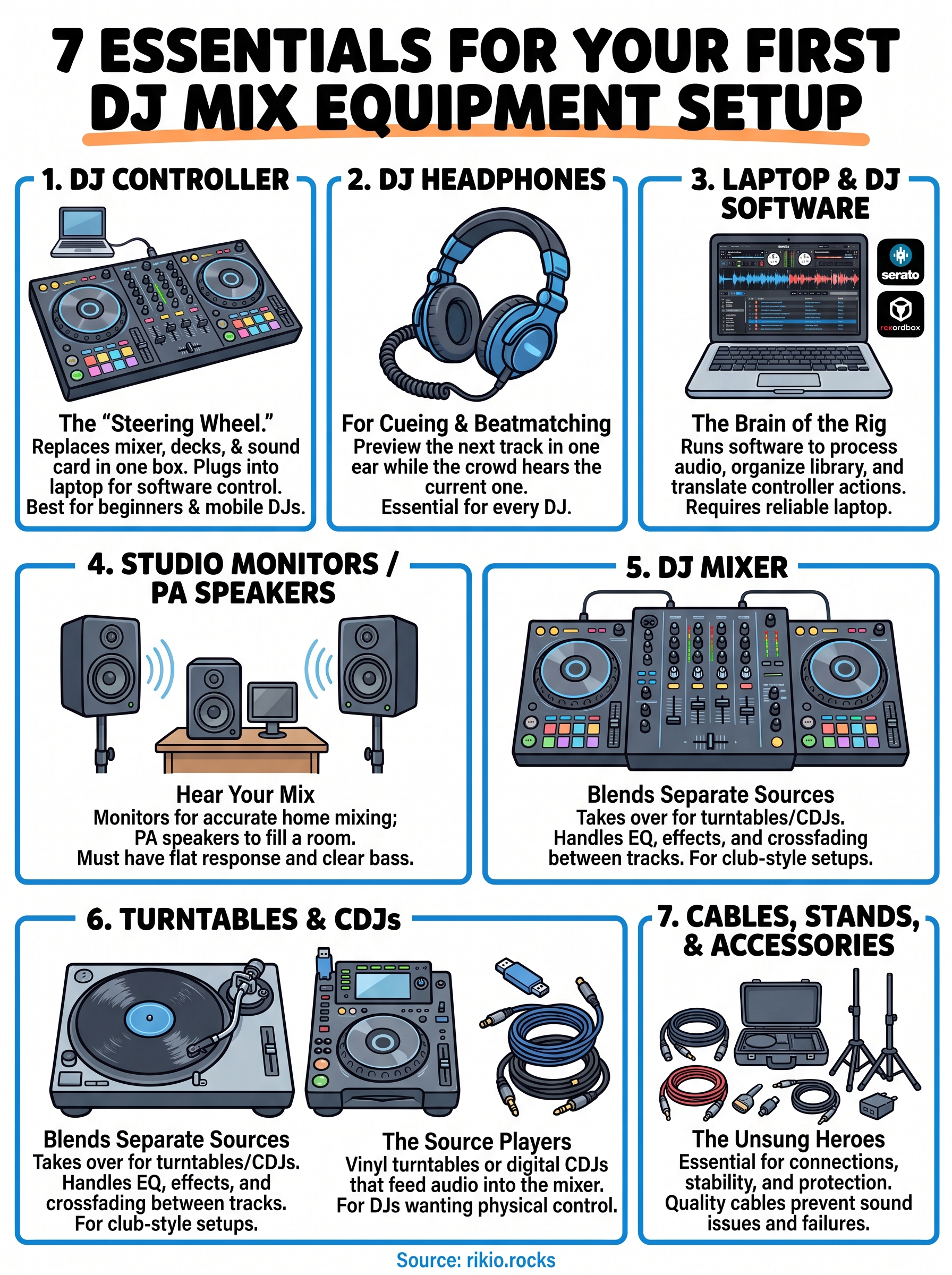
Seven pieces sound like a lot until you realize most beginners only need three to start: a DJ controller, headphones, and a laptop with software. That combo gets you mixing tonight. Everything else, from studio monitors to a full CDJ setup, comes later as you figure out where you actually want to play, whether that's your bedroom, a friend's backyard, or a real club booth.
Skip the temptation to buy everything at once. Grab the controller, learn to beatmatch, and let your next purchase get decided by the venue you're chasing, not the gear you saw online. While you're testing your headphones and dialing in your EQ, cue up our CARDIO HITS 2026 playlist on Spotify. It's packed with high-energy tracks that make great practice material for your first blends.
25