EDM Subgenres Explained: 7 Types Every Fan Should
Know
You hear someone call a track "future bass" or "tech house" and nod along, but honestly, you're not sure what separates one from the other. That confusion is normal. EDM isn't one sound, it's a whole family tree with dozens of branches, and new ones keep sprouting every year at festivals and on SoundCloud.
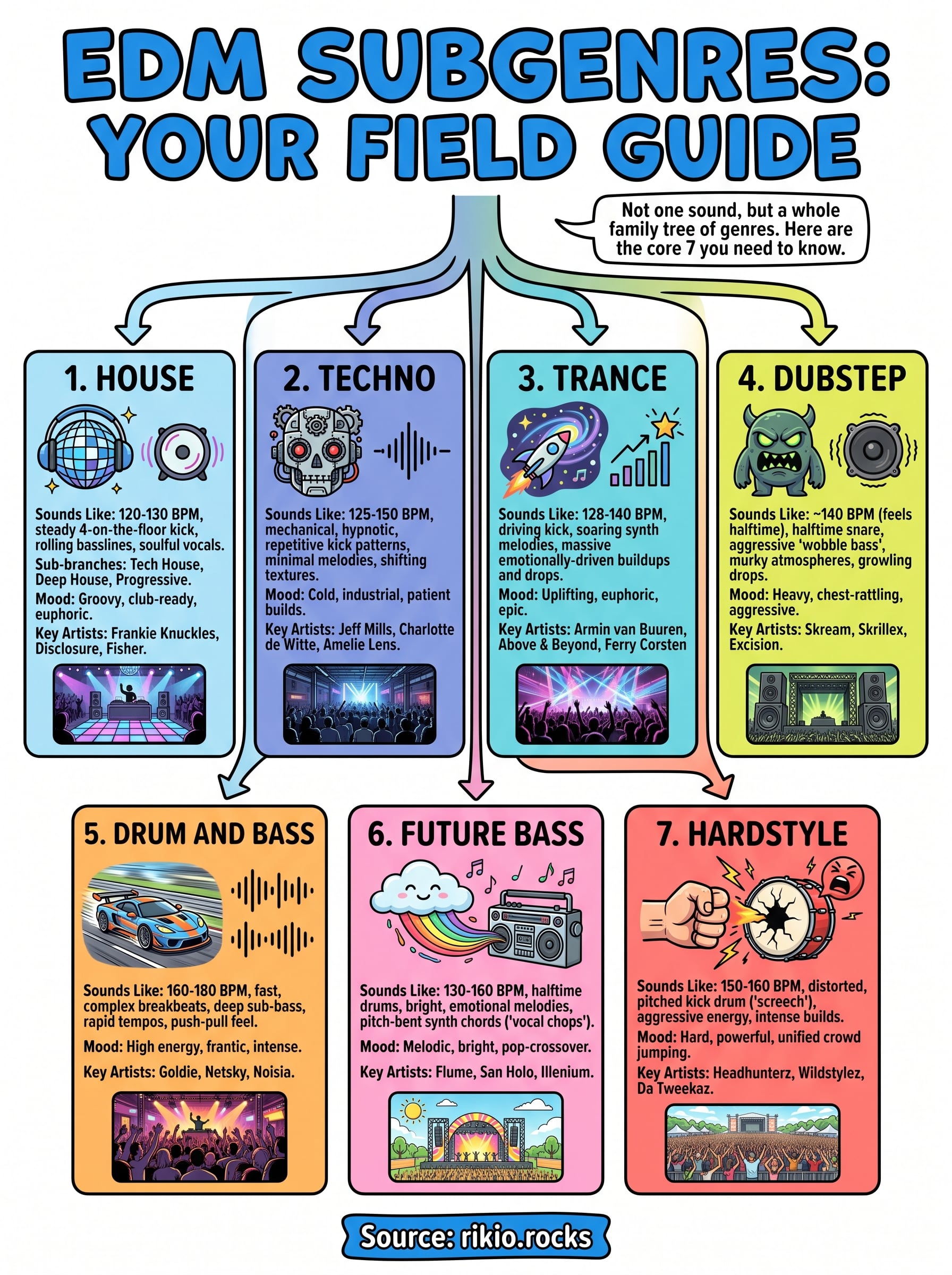
This guide breaks down edm subgenres in plain terms, no music theory degree required. We're not attempting to catalog all 120 subgenres of EDM floating around online lists. Instead, we picked the 7 subgenres every fan should recognize, the ones you'll actually hear at festivals, in DJ sets, and across the tracks blowing up right now.
For each one, you'll get the defining sound, the BPM range, and a few artists or tracks that nail the style. By the end, you'll be able to tell house from techno, trap from dubstep, and explain exactly why they sound nothing alike. If you're the type who reads RIKIO ROCKS daily to keep up with festival lineups and new releases, understanding these core genre differences makes every article, every set, and every lineup announcement click into place.
1. House
House is the genre that started it all, born in Chicago warehouses in the early 1980s when DJs like Frankie Knuckles started looping disco breaks over drum machines. It's the backbone of nearly every other edm subgenre on this list, and if you've ever heard a steady four-on-the-floor kick at a club, you've heard house. Producers kept experimenting with it for decades, which is why you now get sub-branches like tech house, deep house, and progressive house all living under the same roof.
What it sounds like
House runs at a steady 120 to 130 BPM, built on that unmistakable four-on-the-floor kick drum hitting every beat. Layer in a rolling bassline, off-beat hi-hats, and often a soulful or filtered vocal sample, and you've got the formula. Deep house leans warmer and slower with jazzy chords, while tech house brings a punchier, more minimal groove built for peak-time sets. The tempo rarely changes much across sub-styles, but the mood does, from hands-in-the-air euphoria to something you'd play at a rooftop sunset session.
House is the common ancestor almost every other EDM subgenre traces back to.
Key artists to know
Start with these names if you want to understand where house came from and where it's headed:
-
Frankie Knuckles and Larry Heard for the Chicago originals
-
Disclosure for the modern UK garage-influenced sound
-
Fisher and Chris Lake for today's tech house festival anthems
-
Kaytranada for a jazzier, hip-hop-leaning take
Where to hear it live
House dominates club culture more than any other subgenre on this list, so you'll find it every weekend at venues in cities like Ibiza, Berlin, and Miami. Festivals such as Ultra Music Festival and Electric Daisy Carnival dedicate entire stages to house and its offshoots, usually running from afternoon into early evening before the bigger room sounds take over. If you're new to going out, a house set is the easiest entry point since the groove stays consistent and predictable, making it simple to just move and get comfortable with how DJs build energy over an hour-long set.
2. Techno
Techno emerged out of Detroit in the mid-1980s, built by Black producers like Juan Atkins and Derrick May who fused Kraftwerk's robotic synths with Chicago house rhythms. Where house feels warm and soulful, techno strips things down to something colder, more mechanical, and hypnotic. It's one of the electronic music genres that rewards patience since tracks often build for minutes before any real payoff hits.
What it sounds like
Techno typically sits at 125 to 150 BPM, sometimes pushing faster in harder styles. Expect repetitive, driving kick patterns, minimal melodic content, and layers of synth textures that shift gradually rather than dropping suddenly. Vocals are rare, and when they appear, they're usually chopped or processed beyond recognition.
Techno trades melody for hypnotic repetition, and that's exactly the point.
Key artists to know
These names cover the genre's range from underground warehouse sound to festival mainstage energy:
-
Jeff Mills and Robert Hood for the Detroit originators
-
Charlotte de Witte for today's dark, driving festival techno
-
Amelie Lens for hypnotic, minimal club sets
Where to hear it live
Berlin remains techno's spiritual home, with clubs like Berghain shaping the genre's global reputation for marathon, sunrise-to-sunset sets. Stateside, Movement Festival in Detroit celebrates the genre's roots every Memorial Day weekend, while mainstage techno now regularly appears at Ultra and EDC too.
3. Trance
Trance grew out of Germany's early 1990s rave scene, when producers like Sven Väth started stretching techno's hypnotic pulse into longer, more emotional builds. Unlike techno's cold repetition, trance chases euphoria, layering soaring synth melodies over a steady beat until the whole room lifts off together. It's one of the edm subgenres and their subgenres conversations that gets heated fast, since fans split hard between uplifting, psy, and progressive camps.
What it sounds like
Trance runs 128 to 140 BPM, built around a driving kick and a bassline that rarely lets up. What defines it is the buildup: a breakdown strips everything to a single melodic line, tension mounts for sixteen or thirty-two bars, then the full arrangement crashes back in. That drop is the entire emotional payoff of the genre.
Trance is built entirely around the buildup and release, more than any other genre on this list.
Key artists to know
These artists shaped trance from its underground roots to its current festival-mainstage form:
-
Armin van Buuren, whose A State of Trance radio show has run for over 20 years
-
Above & Beyond for melodic, emotionally driven anthems
-
Ferry Corsten for classic uplifting trance
Where to hear it live
Transmission and A State of Trance festivals draw crowds purely for this sound, while Tomorrowland and EDC still reserve dedicated trance stages each year for the genre's loyal following.
4. Dubstep
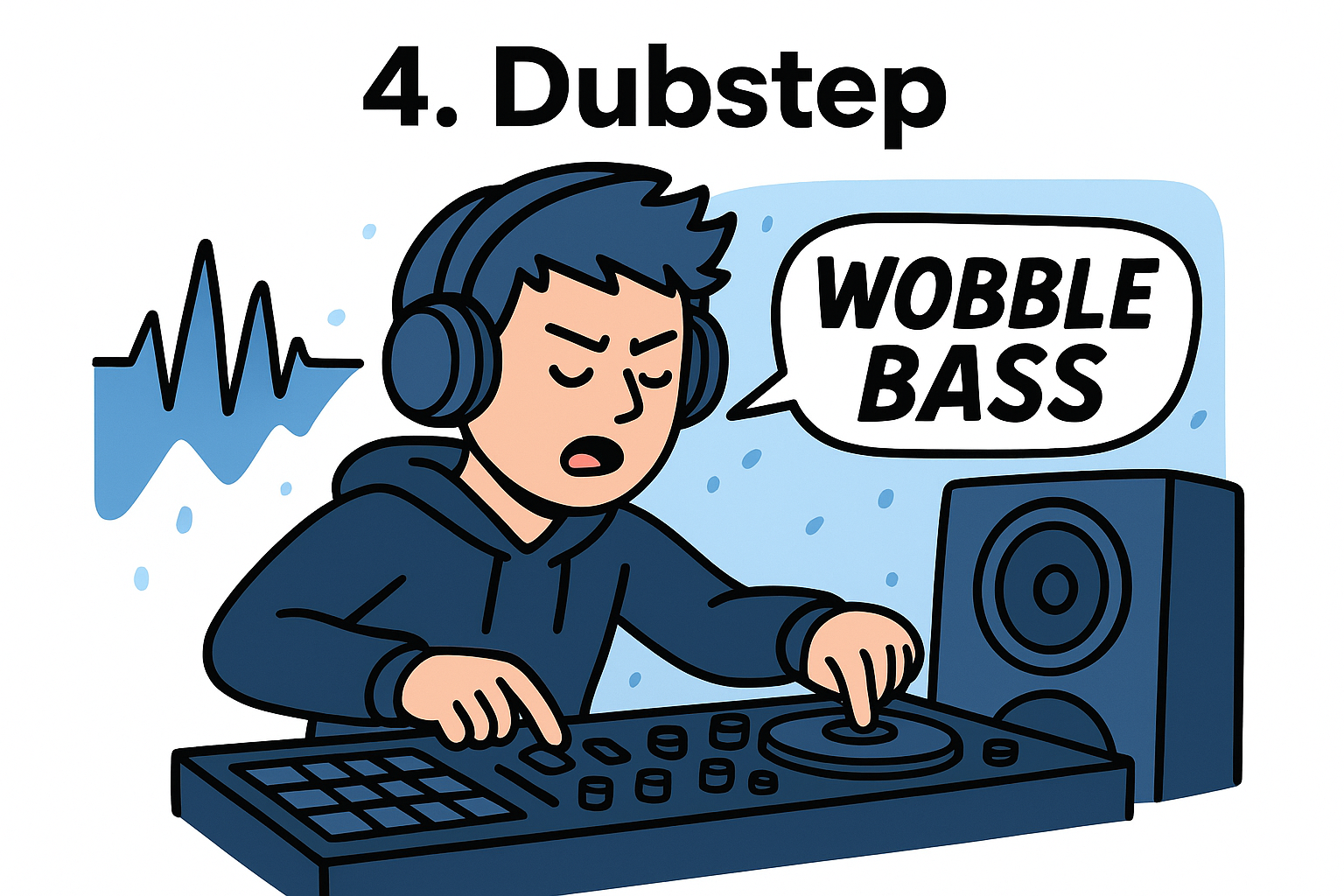
Dubstep started in South London around 2002, growing out of UK garage and 2-step when producers slowed the tempo down and pushed the bass forward until it became the whole point of the track. It's one of the edm subgenres that split into two camps almost immediately, the murky, atmospheric original sound and the aggressive, chest-rattling American strain that took over festival mainstages a decade later.
What it sounds like
Dubstep sits at roughly 140 BPM, but it feels half that speed because the beat emphasizes the halftime snare on beat three instead of every other beat like house or trance. The signature move is the wobble bass, a bass tone that gets pitched, filtered, and distorted until it growls. UK dubstep keeps things spacious and dark, while the American variant, sometimes called brostep, piles on aggressive mid-range "wub" sounds and screeching drops.
Dubstep's whole identity lives in the bass, not the beat.
Key artists to know
These artists cover both branches of the genre's split personality:
-
Skream and Benga for the original UK sound
-
Skrillex for the genre-defining American breakthrough
-
Excision for today's heavier, riff-driven festival style
Where to hear it live
Excision's own Lost Lands festival in Ohio is basically a dubstep pilgrimage at this point, drawing bass-heavy crowds every fall. You'll also catch dedicated bass stages at EDC and Ultra, usually timed for after dark when the heaviest drops hit hardest.
5. Drum and bass
Drum and bass came out of London's early 1990s jungle scene, when producers chopped up breakbeats and sped them up while keeping the bass low and heavy. Fans just call it DnB, and it's one of the edm music subgenres that never really left the underground even as it built a massive global following. The genre demands sharper attention than most, since the drums move fast while the bass often crawls, creating a push-pull that takes a few listens to fully click.
What it sounds like
DnB runs at a blistering 160 to 180 BPM, making it the fastest genre on this list by a wide margin. Rapid, chopped breakbeats drive the track while the bassline stays slower and heavier underneath, creating that signature tension. Liquid DnB softens things with jazzy chords and vocal hooks, while neurofunk goes darker with twisted, sci-fi bass design.
Drum and bass runs its drums twice as fast as its bass, and that contrast is the entire genre.
Key artists to know
-
Goldie and LTJ Bukem for jungle's foundational sound
-
Netsky and Sub Focus for polished, festival-ready liquid DnB
-
Noisia for technical, neurofunk-leaning production
Where to hear it live
Hospitality festival in the UK remains the genre's flagship event, while Shambhala in Canada books some of the deepest DnB lineups in North America. Stateside festivals like EDC now carry dedicated bass stages where DnB gets programmed alongside dubstep.
6. Future bass
Future bass grew out of the early 2010s, when producers like Flume started blending trap's crisp drum programming with lush, detuned synth chords borrowed from R&B and pop. Rather than chasing the aggression of dubstep, this genre leans into bright, emotional melodies, making it one of the more accessible edm subgenres for listeners who find harder styles overwhelming. It also crosses over into mainstream pop production more than almost any other genre on this list, which is why you'll spot its fingerprints on chart hits.
What it sounds like
Future bass typically runs 130 to 160 BPM, though the feel is usually slower thanks to half-time drum patterns. The signature element is a wide, pitch-bent synth chord, often called a "vocal chop" when paired with chopped-up singing, that swells and snaps back rhythmically. Drops favor melody over raw bass weight, trading dubstep's growl for something closer to a pop chorus.
Future bass swaps aggression for melody, and that's exactly why it crossed into pop.
Key artists to know
-
Flume, whose 2012 self-titled album basically defined the genre
-
San Holo for guitar-tinged, emotionally driven production
-
Illenium for anthemic, festival mainstage future bass
Where to hear it live
Future bass shows up across nearly every major festival now, from Coachella's electronic tent to dedicated slots at EDC and Lollapalooza. Illenium's own headline tours draw crowds specifically for this sound, proving it's outgrown its underground roots entirely.
7. Hardstyle
Hardstyle rose out of the Netherlands in the late 1990s, when producers pushed hard trance and gabber together into something faster, harder, and built for jumping in unison. It's one of the edm subgenres that still splits opinion outside its home scene, but inside it, fans are some of the most devoted in electronic music. Where most genres on this list layer subtlety, hardstyle goes straight for maximum impact.
What it sounds like
Hardstyle sits at 150 to 160 BPM, anchored by a distorted, pitched kick drum that functions as both rhythm and melody at once. That reverse-bass kick, sometimes called a "screech," gives the genre its aggressive signature sound. Euphoric hardstyle keeps things melodic and uplifting, closer to trance, while raw hardstyle strips the melody away for something darker and more industrial.
Hardstyle's kick drum carries the melody, not just the rhythm, and that's what makes it instantly recognizable.
Key artists to know
-
Headhunterz for melodic, euphoric hardstyle anthems
-
Wildstylez for polished, festival-ready productions
-
Da Tweekaz for high-energy, crowd-pleasing sets
Where to hear it live
Hardstyle's biggest stage remains Defqon.1 in the Netherlands, where entire fields jump in sync to the kick pattern. Q-Dance, the promoter behind that festival, runs dedicated hardstyle events worldwide, and you'll now find hardstyle stages creeping into EDC and Tomorrowland lineups as the sound gains ground outside Europe.
Finding your sound in EDM
Seven genres, seven completely different feelings, and you now know the difference between a wobble bass and a screech kick. That's the real payoff of learning edm subgenres: once you can name what's hitting your ears, every festival lineup and DJ set stops feeling like noise and starts feeling like a map. House gets you moving, techno hypnotizes, trance lifts you up, dubstep and drum and bass hit you in the chest, future bass keeps things melodic, and hardstyle just goes for broke.
None of this sticks until you actually listen with it in mind. Pull up tracks from the artists mentioned above and notice the BPM, the kick pattern, the drop. Then keep that same energy going during your next workout with our CARDIO HITS 2026 playlist on Spotify, stacked with tracks pulled straight from these subgenres.
8